


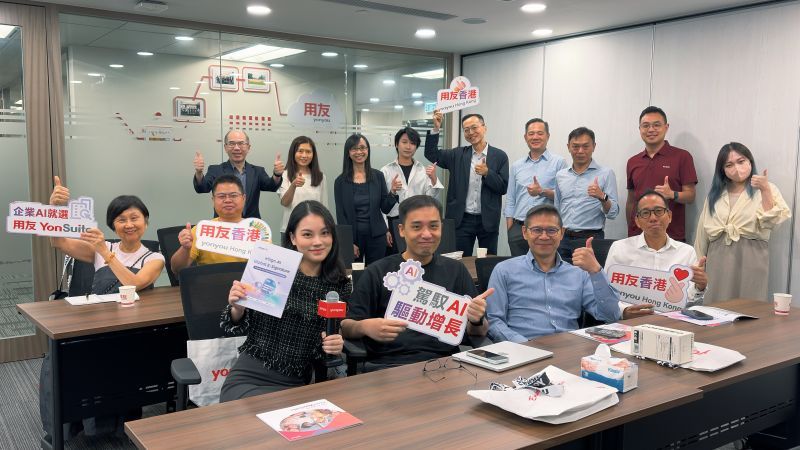
Most Hong Kong HR teams have already bought the signing tool. What they have not fixed is the handoff between three things that were never designed to talk to each other: the HR decision, the signed contract, and the evidence that has to survive an audit two years later. That gap was the subject of a forum co-hosted by ELPPA International Limited, eSign.AI and Yonyou Hong Kong on 5 November 2026.
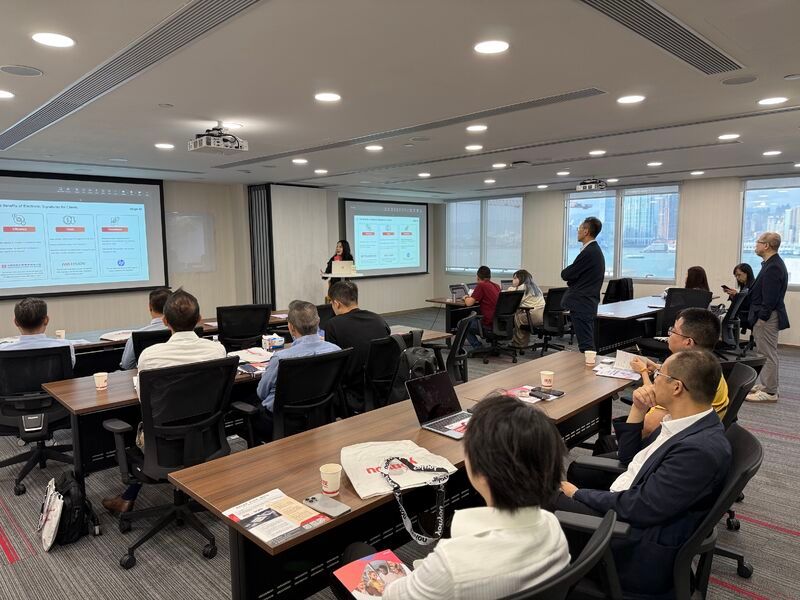
The session drew HR, finance and compliance leads to Yonyou's Wan Chai office for an afternoon built around three questions the paperless conversation usually skips: how AI can be used in HR management without breaking local compliance, how signatures behave once a contract crosses a border, and what identity verification has to prove when a record is challenged.

Where paperless programmes actually lose momentum
The failure is rarely at the moment of signing. It shows up earlier, when an offer letter is approved in an HR system that has no record of who approved it, or later, when the signed document is stored somewhere the audit team cannot reach without a support ticket.
That is a sequencing problem rather than a software problem. A signature applied to a contract whose approval chain is undocumented converts an administrative risk into an evidential one, because the signed page now looks authoritative while the decision behind it does not.
AI in HR meets the PDPO before it meets the workflow
Hong Kong's Personal Data (Privacy) Ordinance (Cap. 486) sets the boundary before any model does. Data Protection Principle 1 requires that personal data be collected for a lawful purpose directly related to a function of the employer and adequate but not excessive for that purpose; Principle 2 requires that it be accurate and kept no longer than necessary.
For recruitment that means the screening data of candidates who were not hired has a retention clock attached to it, and the same clock applies whether the screening was done by a recruiter or a model. The practical consequence is that AI in HR has to be deployed with a deletion path already designed, not retrofitted after the first data access request arrives.
Cross-border contracting: the cost sits in the re-signing
When a Hong Kong entity signs with a mainland affiliate, the visible cost is courier and stamping. The larger cost is the re-signing cycle: a clause changes, and a document that took nine days to move between three offices goes back to the start.
The teams that removed this cost did not remove the approval - they moved it in front of the signature, so the version that reaches the signer is already the approved version. What remains on the other side of the border is a signature that can be verified without a wet-ink original travelling with it.
What an audit trail has to prove when it is challenged
Under the Electronic Transactions Ordinance (Cap. 553), section 5 provides that an electronic record satisfies a requirement for information to be in writing, and section 6 provides that an electronic signature satisfies a requirement for a signature, subject to consent where the transaction is between parties that are not government entities.
That is the legal floor, not the evidential one. When a signed employment contract or supplier agreement is disputed, the question is not whether an electronic signature is permitted but whether this signature can be tied to this person at this time on this document. Three things have to hold: the signer's identity was verified before signing, the intent to sign was captured as an act rather than inferred, and the record shows tampering would have been detected.
eKYC identity verification does the first, the signing ceremony does the second, and a sealed audit trail does the third. Remove any one of them and the remaining two describe a document that is signed but not provable.
Where the Hong Kong framework is stricter than teams assume
For transactions involving government entities, the ETO requires a digital signature supported by a certificate issued by a recognised certification authority, so a simple electronic signature is not enough in that lane. The same asymmetry applies to banking documentation.
This is why the configuration decision matters more than the tool comparison. A platform that applies one signature type everywhere will either over-serve the low-risk documents or under-serve the ones that end up in front of a regulator.
The forum, titled Digital HR x E-Signature: Enabling Paperless Transformation in Hong Kong, was held on 5 November 2026, 14:00-17:00, at Yonyou Hong Kong, 13/F Harcourt House, Wan Chai. It was co-hosted by ELPPA International Limited, eSign.AI and Yonyou Hong Kong.