


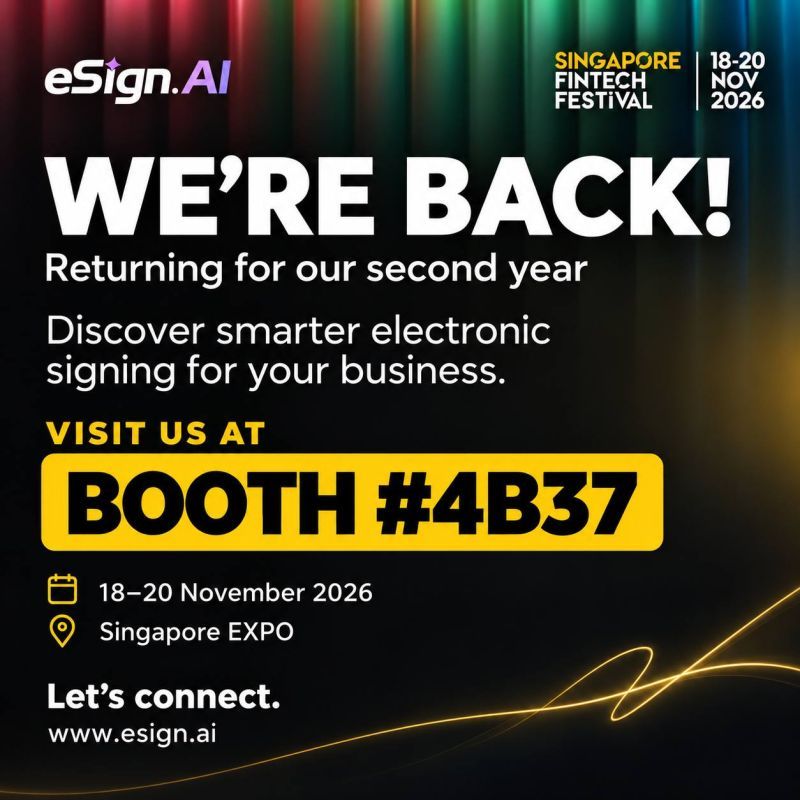
eSign.AI is exhibiting at Singapore FinTech Festival 2026 for the second consecutive year. The festival runs 18 to 20 November 2026 at Singapore EXPO, and eSign.AI will be at Booth 4B37 across all three days.
Why a signing booth at a fintech festival
Most of the conversations that start at a signing booth are not about signing. They are about what happens after a document leaves the room. A regional treasury team signs a facility agreement in Singapore, the counterparty signs in Hong Kong, the original is filed in a third market, and eighteen months later someone in risk or audit has to prove the sequence of events without calling any of the people involved.
That is the question eSign.AI will put in front of visitors at SFF 2026: not whether a signature can be applied electronically, but whether the evidence behind it survives the trip across borders and the passage of time.
What Singapore law actually asks for
The Electronic Transactions Act 2010 answers the first half of the question. Section 8 provides that where a rule of law requires a signature, or provides for certain consequences if a document is not signed, that requirement is satisfied by an electronic signature if a method is used that identifies the signatory and indicates the signatory's intention in respect of the information, and that method is as reliable as appropriate for the purpose for which the information was generated, in the light of all the circumstances.
Read carefully, section 8 is not a permission slip. It is a two-part test: identification plus intention, then reliability assessed against purpose. A typed name at the bottom of an email rarely clears the second part. A certificate-backed signature with a verifiable trust chain and a trusted timestamp usually does, which is why the technical detail in the workflow is not decoration.
Singapore is not an isolated case. Article 25(1) of eIDAS, Regulation (EU) No 910/2014, bars a signature from being denied legal effect solely because it is electronic, and Article 25(2) gives a qualified electronic signature the effect of a handwritten signature. Different statutes, same underlying demand: the verifier has to be able to validate the signature from the document itself.
Three checks that decide whether a signature holds up
First, identity. Who signed, and were they authorised to sign for the entity they claimed to represent. For an SME that means confirming the individual. For a group with subsidiaries it means confirming the individual and the corporate authority behind them, which is the layer that most often lives in a board resolution stored in someone's inbox.
Second, integrity. Whether the document changed after signing. A tamper-evident seal turns that from a promise into something a third party can test without trusting either side.
Third, time. When the signature was applied, and whether that timestamp can be relied on years later, at the point when a tax authority, a bank or a court asks. This is the check that gets skipped in the demo and regretted in the dispute.
What will run at Booth 4B37
The demonstration follows a single agreement end to end rather than showing features in isolation. Signer identity verification at the front, including corporate authorisation where the signer acts for an entity. Signing itself, on web or mobile, with the credential appropriate to the risk of the document. A tamper-evident seal and an audit trail on the finished file, recording who signed, when, from where and with which credential. Then, on the sealed file, clause review and obligation tracking, so the AI layer operates on a document whose integrity was fixed at the moment of signing rather than one that could still move underneath it.
For teams working across Singapore, Malaysia, Indonesia, Vietnam and Hong Kong, the useful part of the conversation is usually corridor-specific: which credential the counterparty will accept, what the local regulator expects to see, and where the evidence has to be stored. Those are answerable questions, and they are the ones worth bringing to the booth.
Where to find us
Singapore FinTech Festival 2026, 18 to 20 November 2026, Singapore EXPO, Booth 4B37. Teams that want a corridor validated before the show can start with our guide to how Singapore's regime treats an electronic signature, and what a counterparty in another market will look for when the document arrives.
Electronic signatures in Singapore: ETA, Singpass and digital signatures
Event: Singapore FinTech Festival 2026, 18-20 November 2026, Singapore EXPO. eSign.AI will exhibit at Booth 4B37.