


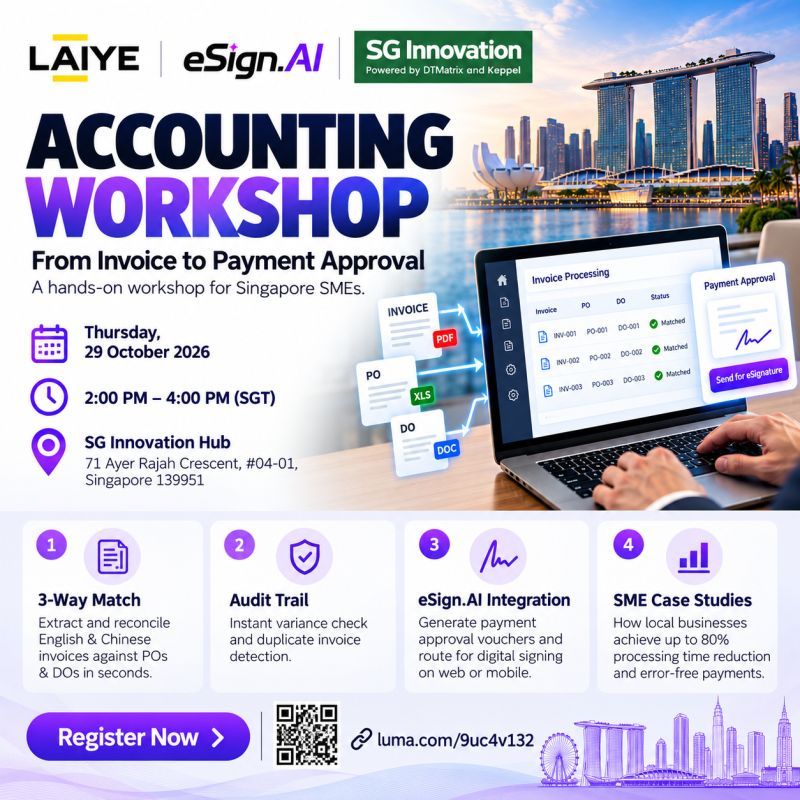
eSign.AI joined Laiye and SG Innovation, powered by DTMatrix and Keppel, to run a hands-on AI accounting workshop for Singapore SMEs at the SG Innovation Hub on 29 October 2026. The session followed one invoice from arrival to released payment, and the signing step turned out to be where most of the audit questions land.
The gap sits between matching an invoice and releasing money
Accounts payable teams have largely solved the first half of the problem. Invoice capture, three-way matching against the purchase order and delivery order, variance flagging and duplicate detection are all routine now, and for English and Chinese invoices they are fast. What remains stubbornly manual is the moment the matched invoice has to become a payment the finance director is willing to sign off on.
That moment produces a document, usually a payment approval voucher, that has to carry an authorisation trail. It is the document a bank may ask for, the document an auditor will sample, and the document that in a dispute has to show who approved what, in which order, and on what basis.
Four things the workshop covered
The first was three-way matching: extracting and reconciling English and Chinese invoices against purchase orders and delivery orders, then surfacing only the exceptions that need a human.
The second was the audit layer around it: instant variance checks and duplicate invoice detection, so the anomaly is caught before the payment run rather than after it.
The third was the hand-off into signing. Once a payment approval voucher is generated, it is routed for digital signing on web or mobile, so the approval carries the same evidence standard as a contract rather than living as an email reply that says approved.
The fourth was the case-study segment, covering how local businesses reduce invoice processing time and close payments without reconciliation errors. Attendees spent most of the session on their own workflows rather than watching a slide deck, which is the point of calling it hands-on.
Why the signature step decides the audit question
Singapore sets the retention bar clearly. IRAS requires GST records to be kept for at least five years from the end of the relevant accounting period, and applies the same five-year rule to income tax records from the relevant Year of Assessment. Five years is long enough that nobody who approved a voucher in 2026 will reliably remember it in 2031.
That is why the evidence has to be in the document rather than in a person's memory. The Electronic Transactions Act 2010, section 8, sets the test: an electronic signature satisfies a legal signature requirement where a method is used that identifies the signatory and indicates their intention, and that method is as reliable as appropriate for the purpose. For an internal approval, that means the record has to show who approved, in what capacity, at what time, and whether the document changed afterwards.
A signed PDF with a certificate, a timestamp and an audit trail answers all of that from the file itself. A chain of email replies does not, which is why AP automation projects tend to stall at exactly this hand-off.
What this changes for a finance team
The practical gain is not that approvals become electronic. It is that the invoice, the match result, the approval and the signature end up in one traceable object, so a five-year-old payment can be reconstructed in minutes instead of an afternoon of mailbox archaeology. For an SME without a dedicated internal audit function, that difference is the whole compliance story.
Teams that want to extend the same workflow beyond payment vouchers, into purchase orders, supplier contracts and delivery documentation, can start with our guide to where electronic signatures fit across procurement and supply chain.
Event: AI Accounting Workshop, 29 October 2026, 2:00-4:00 PM SGT, SG Innovation Hub, 71 Ayer Rajah Crescent #04-01, Singapore 139951. Organised by Laiye with eSign.AI and SG Innovation, powered by DTMatrix and Keppel.