
'%3e%3cpath%20fill-rule='evenodd'%20clip-rule='evenodd'%20d='M6.99935%2012.8327C10.221%2012.8327%2012.8327%2010.221%2012.8327%206.99935C12.8327%203.77769%2010.221%201.16602%206.99935%201.16602C3.77769%201.16602%201.16602%203.77769%201.16602%206.99935C1.16602%2010.221%203.77769%2012.8327%206.99935%2012.8327Z'%20stroke='%23666666'%20stroke-linecap='round'%20stroke-linejoin='round'/%3e%3cpath%20d='M1.16602%207H12.8327'%20stroke='%23666666'%20stroke-linecap='round'%20stroke-linejoin='round'/%3e%3cpath%20fill-rule='evenodd'%20clip-rule='evenodd'%20d='M6.99935%2012.8327C8.28802%2012.8327%209.33268%2010.221%209.33268%206.99935C9.33268%203.77769%208.28802%201.16602%206.99935%201.16602C5.71068%201.16602%204.66602%203.77769%204.66602%206.99935C4.66602%2010.221%205.71068%2012.8327%206.99935%2012.8327Z'%20stroke='%23666666'%20stroke-linecap='round'%20stroke-linejoin='round'/%3e%3cpath%20d='M2.875%202.95898C3.93063%204.01461%205.38896%204.66754%206.99978%204.66754C8.61062%204.66754%2010.069%204.01461%2011.1246%202.95898'%20stroke='%23666666'%20stroke-linecap='round'%20stroke-linejoin='round'/%3e%3cpath%20d='M11.1246%2011.0425C10.069%209.98691%208.61062%209.33398%206.99978%209.33398C5.38896%209.33398%203.93063%209.98691%202.875%2011.0425'%20stroke='%23666666'%20stroke-linecap='round'%20stroke-linejoin='round'/%3e%3c/g%3e%3cdefs%3e%3cclipPath%20id='clip0_1267_9109'%3e%3crect%20width='14'%20height='14'%20fill='white'/%3e%3c/clipPath%3e%3c/defs%3e%3c/svg%3e)


DPP Series | Part 1: Why Chinese Exporters Need to Prepare for the EU Digital Product Passport


The EU Digital Product Passport (DPP) is moving from policy design into operational infrastructure. For Chinese manufacturers and exporters, this is not simply another certificate to prepare before shipment. It represents a new way for product information, market-access evidence, and supply-chain data to be identified, accessed, verified, and maintained throughout a product's life cycle.
What is the EU Digital Product Passport?
The Digital Product Passport is a product-specific digital record introduced through the EU's Ecodesign for Sustainable Products Regulation (ESPR). Depending on the product-specific rules that apply, a DPP can make structured information available to customers, manufacturers, importers, distributors, repairers, recyclers, market-surveillance authorities, customs authorities, and other authorised parties.
A DPP is normally connected to a product through a data carrier such as a QR code. But the QR code is only the access point. The real obligation is the digital information system behind it: unique identifiers, governed product data, defined access rights, reliable hosting, security controls, and data that remains available for the required period.
This distinction matters. A company can generate a QR code in minutes. Building an accurate and maintainable product-data chain across suppliers, factories, systems, and EU economic operators takes much longer.
Why DPP matters to Chinese exporters
Chinese companies manufacture a substantial share of the batteries, electronics, textiles, steel, aluminium, tyres, furniture, and energy-related products sold into Europe. These sectors are also prominent in the EU's 2025-2030 ESPR working plan and related product legislation.
That does not mean every product in these sectors already has an active DPP obligation. Product-specific requirements are introduced through delegated acts or separate EU legislation, and their scope and application dates must be checked individually. It does mean that exporters in these value chains should begin mapping their exposure now.
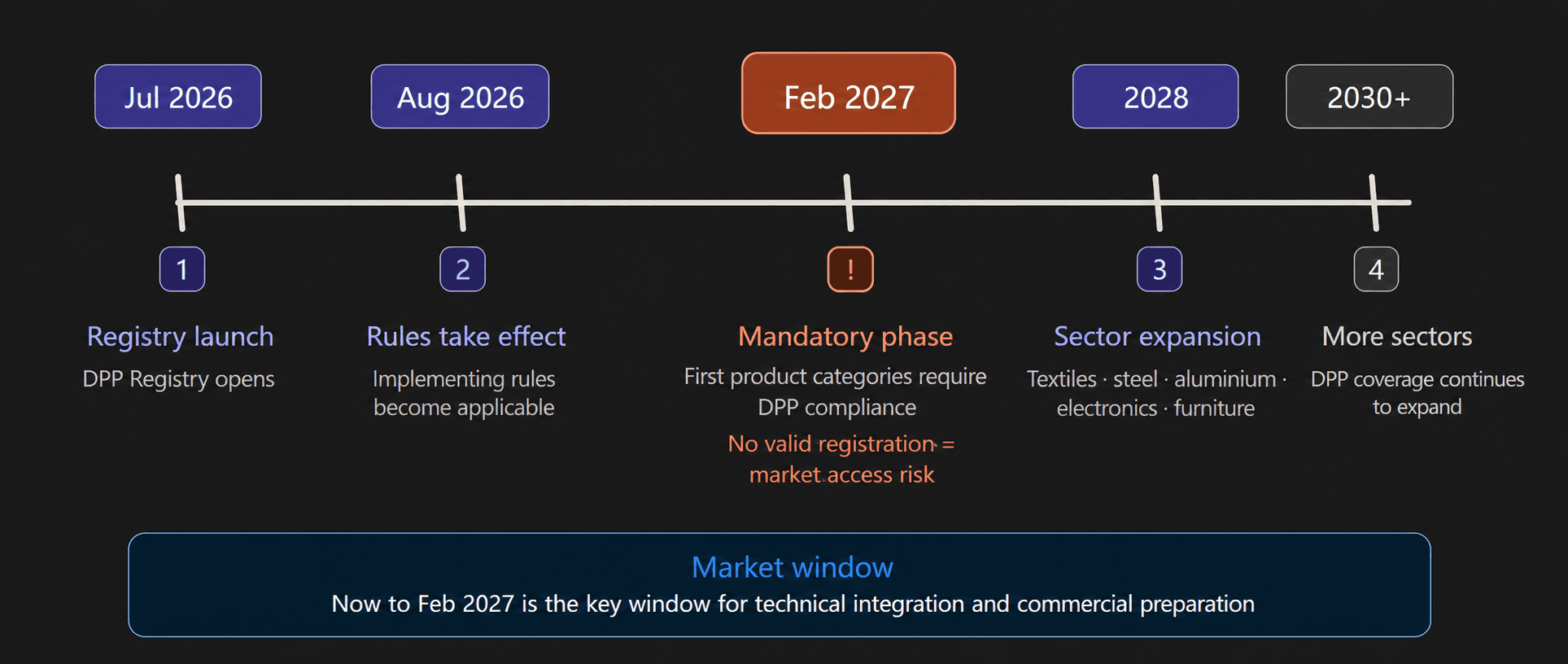
The first major confirmed milestone is the battery passport. Under Regulation (EU) 2023/1542, from 18 February 2027, each light means of transport battery, each industrial battery with a capacity greater than 2 kWh, and each electric vehicle battery placed on the EU market or put into service must have an electronic battery passport.
DPP changes how EU market-access evidence is managed
Traditional export compliance has often been document-centred. A company collects declarations, certificates, test reports, bills of materials, and shipping records, then presents them when a customer or authority asks.
DPP introduces a more data-centred model. The relevant information needs to be associated with the correct product, batch, or item; made available to the right party; protected from unauthorised changes; and kept current over time. The ESPR also requires data authentication, reliability, and integrity, as well as a high level of security and privacy.
For an exporter, this can affect more than the compliance department:
- Product teams need to determine which models, variants, and components are within scope.
- Procurement teams need consistent sustainability and materials data from suppliers.
- IT teams need identifiers and interfaces that connect data across ERP, PLM, MES, quality, and compliance systems.
- Legal and compliance teams need clear responsibility for creating, updating, approving, and retaining DPP information.
- EU importers or other economic operators need an agreed process for registration, permissions, and communication with authorities.
Five preparation questions for exporters
1. Which products and legal entities are in scope?
Start with product families, customs classifications, destination markets, and the role each group company plays in the EU supply chain. A manufacturer outside the EU, an EU importer, and an authorised representative may have different responsibilities.
2. Where does the required product data come from?
Map data owners and source systems. Material composition may sit with suppliers, technical specifications with PLM, production data with MES, commercial product records with ERP, and conformity evidence with quality or compliance teams.
3. How will products be uniquely identified?
The identifier model may operate at model, batch, or individual-item level, depending on the applicable rules. It needs to connect the physical product and its data carrier to the correct digital record without creating duplicates or broken links.
4. Who can create, change, and access the information?
DPP information can have different access levels. Companies need permission models for public data, restricted data, authority access, and commercially sensitive information. They also need a controlled process for correcting or updating records.
5. Can the evidence still be trusted years later?
Product information can outlive the system or supplier that originally created it. Companies should therefore plan for availability, change history, timestamps, evidence retention, and verification after organisational or technology changes.
Why exporters should not wait for the final deadline
DPP readiness is a cross-functional data programme, not a last-minute labelling exercise. Waiting until a product-specific deadline can leave too little time to resolve supplier-data gaps, inconsistent identifiers, unclear economic-operator roles, or integration constraints.
A practical first phase does not require building the complete future system. Companies can begin with a scope assessment, one priority product family, a data-gap analysis, an ownership model, and a pilot connection between the source systems and the passport data layer.
This work can also produce value beyond compliance. Cleaner product data, stronger supplier evidence, more reliable audit trails, and better system integration can improve customer due diligence, repair and recycling workflows, and supply-chain transparency.
From DPP readiness to an eSign.AI delivery path
eSign.AI provides the digital trust, qualified-seal and signing infrastructure needed to turn DPP preparation into an operating process. The solution covers two distinct tracks: verifying the economic operator and signing or sealing regulated product data and supporting documents.
For organisation verification, eSign.AI supports Qualified Electronic Seal (QSeal) application and delivery through its Registration Authority service and integration with ANF AC, an EU trusted-list qualified trust service provider. The service can guide non-EU manufacturers through identity verification, certificate-information checks and the organisation-seal step used in registry-facing onboarding workflows.
For product and compliance data, eSign.AI supports PAdES for PDF workflows and XAdES/JAdES long-term signature formats for structured XML or JSON records, together with qualified timestamps and evidence retention. Customers can use SaaS, SDK or API integration according to document format and transaction volume. Batch-oriented APIs can reduce manual work when a registry or business process accepts multiple DPP records in one submission.
This delivery model builds on eSign.AI's eCoC work. The same QSeal foundation, business-system integration and trusted evidence controls can be reused for DPP onboarding and signing scenarios, while product-specific data and legal requirements remain separately governed. The EU eCoC 2.0 readiness guide explains the related market access workflow.
Start with a readiness assessment
Chinese exporters do not need to predict every future delegated act. They do need to understand where they are exposed, which data is already available, where responsibility sits, and which trust and integration capabilities are missing.
In the past, products entered global markets mainly with documents. In the DPP era, they will increasingly need trusted, structured, and accessible data as well.
This article provides a general regulatory and operational overview and is not legal advice. Companies should confirm the product-specific rules, application dates, and economic-operator obligations that apply to their products.
DPP Series
- Part 1: Why Chinese Exporters Need to Prepare for the EU Digital Product Passport (this article)
- Part 2: DPP Deep Dive: How Companies Use It, Plan Usage, and Integrate
- Part 3: From eCoC to QSeal: How eSign.AI Supports DPP Readiness
FAQs