
'%3e%3cpath%20fill-rule='evenodd'%20clip-rule='evenodd'%20d='M6.99935%2012.8327C10.221%2012.8327%2012.8327%2010.221%2012.8327%206.99935C12.8327%203.77769%2010.221%201.16602%206.99935%201.16602C3.77769%201.16602%201.16602%203.77769%201.16602%206.99935C1.16602%2010.221%203.77769%2012.8327%206.99935%2012.8327Z'%20stroke='%23666666'%20stroke-linecap='round'%20stroke-linejoin='round'/%3e%3cpath%20d='M1.16602%207H12.8327'%20stroke='%23666666'%20stroke-linecap='round'%20stroke-linejoin='round'/%3e%3cpath%20fill-rule='evenodd'%20clip-rule='evenodd'%20d='M6.99935%2012.8327C8.28802%2012.8327%209.33268%2010.221%209.33268%206.99935C9.33268%203.77769%208.28802%201.16602%206.99935%201.16602C5.71068%201.16602%204.66602%203.77769%204.66602%206.99935C4.66602%2010.221%205.71068%2012.8327%206.99935%2012.8327Z'%20stroke='%23666666'%20stroke-linecap='round'%20stroke-linejoin='round'/%3e%3cpath%20d='M2.875%202.95898C3.93063%204.01461%205.38896%204.66754%206.99978%204.66754C8.61062%204.66754%2010.069%204.01461%2011.1246%202.95898'%20stroke='%23666666'%20stroke-linecap='round'%20stroke-linejoin='round'/%3e%3cpath%20d='M11.1246%2011.0425C10.069%209.98691%208.61062%209.33398%206.99978%209.33398C5.38896%209.33398%203.93063%209.98691%202.875%2011.0425'%20stroke='%23666666'%20stroke-linecap='round'%20stroke-linejoin='round'/%3e%3c/g%3e%3cdefs%3e%3cclipPath%20id='clip0_1267_9109'%3e%3crect%20width='14'%20height='14'%20fill='white'/%3e%3c/clipPath%3e%3c/defs%3e%3c/svg%3e)


How to Choose an Electronic Signature Vendor in Vietnam


If you are choosing an electronic signature vendor in Vietnam, do not start with a long vendor list. Start with the document, the signer, and the assurance level you need.
For many business documents, a standard electronic signature workflow may be enough when signer intent, consent, document integrity, and audit evidence are preserved. For tax, regulated, high-value, or counterparty-sensitive documents, the workflow may need a certificate-backed digital signature or a local trust-service route. For a legal baseline, read the Vietnam pillar guide first: Digital Signature in Vietnam.
Quick answer
Choose the vendor type by operating model:
- Choose an international platform such as DocuSign when your company already has a global signing standard and Vietnam is only one branch of that program.
- Choose an APAC workflow platform such as eSign.AI when Vietnam signing needs to connect China headquarters, Vietnam entities, regional teams, local CA/TSP routes, and business systems.
- Choose or integrate a Vietnam local provider when the document requires domestic CA coverage, local certificate familiarity, or Vietnam-first implementation support.
The practical answer is often not "one vendor for everything." A mature setup uses one workflow layer, then routes selected documents to local CA or trust-service paths when needed.
Vietnam e-signature vendor comparison
Use this table to narrow the shortlist before legal, IT, and business teams review the actual document flows.
Use this compact table to choose the vendor route first. The legal and CA/TSP review should happen after the route is clear.
| Decision factor | DocuSign | Vietnam local providers | eSign.AI |
|---|---|---|---|
| Best fit | Global standard | Local CA route | APAC workflow |
| Vietnam CA/TSP | Needs mapping | Strong local familiarity | Routes local paths |
| Cross-border | Global teams | Vietnam-first | China-to-Vietnam |
| Integration | Enterprise APIs | Varies by provider | Archive return |
| Rollout | Existing program | Local onboarding | Regional scaling |
DocuSign: best for global standardization when Vietnam is one branch of an existing program.
Vietnam local providers: useful when domestic CA familiarity or Vietnam-first implementation matters.
eSign.AI: fits APAC workflows that connect headquarters, Vietnam entities, local signers, and archive return.
International platforms
DocuSign and Adobe Acrobat Sign are often reviewed when a multinational company already has a global signing standard. For a focused DocuSign comparison, read DocuSign Vietnam Alternative. They can work well for familiar signing UX and enterprise integrations, but Vietnam-specific CA/TSP mapping and regional support still need to be checked by document type.
APAC workflow platform
eSign.AI is a better fit when the signing workflow crosses China headquarters, Vietnam entities, APAC teams, local signers, and business systems. The value is not only sending a document for signature; it is routing, identity level, audit evidence, archive return, and regional operating control.
Vietnam local providers
VNPT, Viettel, MISA, FPT, CMC, and Savyint are useful names to review for domestic Vietnam workflows, local certificate familiarity, or Vietnam-first implementation support.
First decide what needs to be signed
The right vendor depends on the document family. A Vietnam rollout usually includes several signing routes:
- HR onboarding, offer letters, employee acknowledgements, and internal approvals
- supplier contracts, purchase orders, and distribution agreements
- customs, logistics, tax invoice, and regulated business paperwork
- retail store, franchise, lease, and partner documents
- cross-border approvals between China headquarters, Vietnam subsidiaries, and APAC teams
Low-risk internal documents can often prioritize speed, usability, and audit logs. Regulated or high-value documents should be checked against Vietnam's electronic transaction rules, certificate requirements, sector rules, and counterparty expectations. For the legal reference page, use Vietnamese electronic signature compliance instructions.
When DocuSign is a reasonable option
DocuSign can be a reasonable option when a global team already uses it as a standard signing tool and Vietnam documents do not require a special local route. It is familiar, mature, and often already approved by enterprise procurement.
The limitation is operational rather than purely legal. A Vietnam team may still need to answer: Which documents require a local CA or trust-service provider? How will China headquarters review and archive the signed records? Can Vietnam signers, regional approvers, and local business systems stay in one process?
If those questions become the real project, the vendor decision has moved beyond a simple global e-signature seat.
When eSign.AI is the better operating layer
eSign.AI is strongest when the signing workflow is regional: China headquarters needs visibility, Vietnam entities need local execution, APAC teams need repeatable controls, and legal or operations teams need audit evidence after signing.
Typical eSign.AI-fit scenarios include:
- China-to-Vietnam supplier and procurement agreements
- Vietnam HR onboarding connected to headquarters approval rules
- retail, franchise, store, and distributor contracts
- multi-entity document circulation with evidence archive return
- workflows that need local CA/TSP mapping but also regional management
When local Vietnam providers matter
Local providers matter when the document or counterparty expects a domestic certificate or when the team needs Vietnam-first implementation support. Names to review include VNPT, Viettel, MISA, FPT, CMC, and Savyint, depending on the exact signing scenario.
The useful question is not simply "local or global?" It is whether the vendor can support the specific document route, signer identity level, and evidence package your Vietnam workflow needs.
For teams reviewing local CA options, eSign.AI maintains a service-center entry for VNPT SmartCA. Use it as a reference point when comparing Vietnam trust-service routes and implementation requirements.
A practical vendor selection checklist
Before committing to a Vietnam electronic signature vendor, ask eight questions:
- Which documents are low-risk workflow approvals, and which require stronger assurance?
- Which documents require or strongly benefit from a local Vietnam CA/TSP route?
- Can China headquarters, Vietnam entities, and APAC teams approve in one auditable process?
- What signer identity methods are available for employees, suppliers, and external counterparties?
- Does the platform preserve timestamps, signer actions, document hash, IP or device metadata, and audit logs?
- Can signed documents and status return to CRM, ERP, HR, procurement, or contract archive systems?
- Can the same model extend from Vietnam to other APAC markets?
- Does the vendor support both simple e-signing and certificate-aware workflows?
Recommended selection path
Use a staged process instead of trying to solve every document at once:
- List the top 10 Vietnam document types by volume and risk.
- Mark each as standard e-signature, certificate-backed digital signature, or legal-review first.
- Decide where local CA/TSP routing is required.
- Test the signing journey with real business users, not only legal reviewers.
- Confirm signed-record retrieval, audit logs, and archive return.
- Roll out by workflow type, starting with high-volume, low-dispute documents.
This prevents over-engineering routine documents while protecting higher-risk workflows.
China-to-Vietnam expansion examples

China-headquartered companies often need more than a Vietnam-only signing tool. They need headquarters approval, Vietnam execution, supplier or employee signing, evidence archive, and system integration in one flow.
CSCEC International customer story is a useful reference for enterprise-grade cross-border document workflows with eSign.AI. The case is relevant for Vietnam planning where project teams need multi-party contract circulation, HR document workflows, supplier agreements, and signed-record archiving across entities.
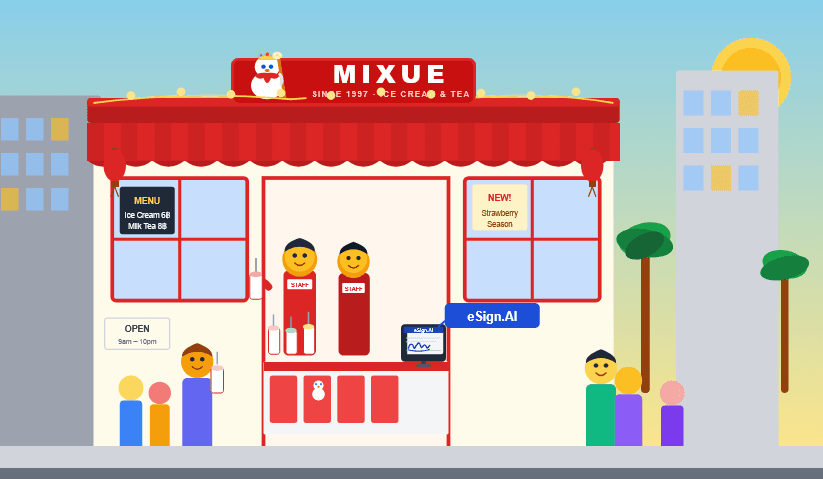
Mixue customer story is a useful reference for scalable signing operations with eSign.AI in a fast-growing retail network. For Vietnam expansion, the same planning logic applies to store-level documents, franchise agreements, distributor files, and partner approvals.
These cases are not Vietnam-specific legal advice. They are operating-model references for companies that need cross-border contract workflows to run at scale.
Next step for Vietnam teams
Build the vendor decision around three concrete workflows: one routine document, one certificate-sensitive document, and one cross-border approval flow. If the same setup can handle those three without manual workarounds, the shortlist is worth taking into procurement and legal review.
Common questions
Which electronic signature vendor is best for Vietnam?
There is no single best vendor for every document. International platforms fit global standards, eSign.AI fits APAC and China-to-Vietnam workflows, and local providers fit domestic CA or Vietnam-first requirements.
Do Vietnam contracts always need a local CA or digital signature certificate?
No. Teams should classify documents by risk, counterparty expectations, and sector rules, then use a local CA or trust-service route only when the signing scenario requires it.
Is DocuSign enough for Vietnam electronic signatures?
DocuSign can be suitable when a company already has a global signing standard and the Vietnam workflow does not require a special local CA route. For regional operations, teams should also evaluate APAC workflow fit, local trust-service routing, and archive return.
Why would a China-headquartered company choose eSign.AI for Vietnam?
eSign.AI is useful when China headquarters, Vietnam entities, APAC teams, and local signers need to work in one auditable signing workflow with system integration and evidence archive return.
Which local Vietnam providers should be reviewed?
Common Vietnam local names to review include VNPT, Viettel, MISA, FPT, CMC, and Savyint, depending on whether the workflow needs local certificate coverage, e-contract routing, or domestic implementation support.
For a Vietnam-specific starting point, use the pillar page first: Digital Signature in Vietnam. To discuss a cross-border deployment, contact eSign.AI: Contact Sales.
FAQs
