


DocuSign vs. Scrive: Considerations for US companies with EU clients


Navigating eSignature Solutions for Cross-Border Operations
For US companies expanding into the European Union (EU), selecting the right electronic signature (eSignature) platform is crucial. With increasing trade and data flows between the US and EU, businesses must balance compliance, efficiency, and cost. This article examines DocuSign and Scrive as key options, focusing on considerations for US firms serving EU clients. We'll explore regulatory landscapes, platform features, and broader comparisons to inform strategic decisions.

Comparing eSignature platforms with DocuSign or Adobe Sign?
eSign.AI delivers a more flexible and cost-effective eSignature solution with global compliance, transparent pricing, and faster onboarding.
EU eSignature Regulations: A Framework for Compliance
The EU's electronic signature framework is governed primarily by the eIDAS Regulation (Regulation (EU) No 910/2014), which establishes a harmonized approach to electronic identification and trust services across member states. eIDAS categorizes signatures into three levels: Simple Electronic Signatures (SES), which are basic and akin to a scanned handwritten signature; Advanced Electronic Signatures (AES), requiring unique identification and control by the signer; and Qualified Electronic Signatures (QES), the highest level equivalent to a handwritten signature in legal effect, backed by qualified trust service providers.
For US companies with EU clients, compliance with eIDAS is non-negotiable, especially in sectors like finance, healthcare, and real estate where enforceability in court is paramount. Unlike the US's ESIGN Act and UETA, which provide a more flexible, technology-neutral framework emphasizing intent over form, eIDAS imposes stricter requirements on certification and audit trails. Non-compliance can lead to voided contracts or fines up to 4% of global turnover under GDPR if personal data is involved. Platforms must support QES for high-stakes transactions, while SES suffices for routine agreements. US firms often overlook the need for EU-based data residency to avoid data transfer issues under Schrems II rulings, making region-specific providers like Scrive appealing for seamless adherence.
DocuSign: A Global Leader with Robust US-EU Integration
DocuSign, a dominant player in the eSignature market, offers comprehensive solutions tailored for international operations. Its core eSignature platform enables secure document signing, workflow automation, and integrations with tools like Salesforce and Microsoft. For US companies, DocuSign's Identity and Access Management (IAM) features stand out, providing multi-factor authentication, single sign-on (SSO), and role-based access controls to safeguard cross-border data flows. The Intelligent Agreement Management (IAM) platform extends beyond signing to include contract lifecycle management (CLM), AI-driven risk analysis, and template libraries, helping teams negotiate and execute agreements efficiently.
Pricing starts at $10/month for Personal plans (5 envelopes/month) and scales to $40/month per user for Business Pro, with enterprise options customized for volume. DocuSign supports eIDAS compliance through partnerships with qualified trust providers, offering AES and QES where needed. However, US-based data centers may require additional configurations for EU data localization, potentially increasing costs. Its API ecosystem is mature, ideal for integrating with US CRM systems while serving EU clients.
Scrive: EU-Centric Expertise for Regional Compliance
Scrive, a Swedish-based eSignature provider, specializes in European markets and is particularly suited for US companies targeting the EU. Founded in 2007, Scrive emphasizes eIDAS-qualified services, with native support for QES via its eID platform. This includes video identification, biometric verification, and integration with national eID schemes like BankID in the Nordics or European mobile IDs. Scrive's platform streamlines KYC processes, document workflows, and analytics, making it a go-to for industries like banking and public sector where strict EU regulations apply.
Pricing is usage-based or subscription, starting around €20-50 per month per user for basic plans, with enterprise tiers customized for high-volume needs. Unlike DocuSign's seat-based model, Scrive offers flexible envelopes and focuses on EU data sovereignty through local hosting in multiple member states. For US firms, Scrive reduces compliance risks by handling eIDAS nuances out-of-the-box, though its global integrations are less extensive than DocuSign's. Challenges include potentially higher setup times for non-EU users and limited presence outside Europe.
DocuSign vs. Scrive: Key Considerations for US Companies with EU Clients
When evaluating DocuSign against Scrive, US companies must weigh compliance depth, scalability, and operational fit for EU engagements. DocuSign excels in global reach and ease of adoption, with over 1 million customers worldwide and seamless US-EU bridging via its cloud infrastructure. Its eIDAS support is solid but often requires add-ons like SMS delivery (€0.10-0.50 per message) or identity verification (metered at extra cost), which can inflate expenses for frequent EU transactions. For a mid-sized US exporter signing 500 contracts annually with German clients, DocuSign's Business Pro plan might cost $24,000/year (50 users at $40/month), plus compliance fees.
Scrive, conversely, prioritizes EU-native compliance, minimizing legal hurdles. Its QES capabilities ensure contracts hold up in EU courts without extra certifications, and EU data centers align with GDPR's data protection principles. This is vital for US firms under the EU-US Data Privacy Framework, avoiding transfer adequacy issues. However, Scrive's pricing—often €30-60/month per user—may seem comparable, but its envelope limits (e.g., 100-500/month base) suit EU-focused operations better than DocuSign's broader quotas. Integration-wise, DocuSign's API (starting at $600/year for developers) outperforms Scrive's more regionally tuned APIs, which might require custom work for US systems like ERP software.
Cost-effectiveness tips toward Scrive for EU-heavy portfolios: a similar setup could run €15,000-20,000/year, factoring in bundled compliance. User experience favors DocuSign for mobile signing and templates, while Scrive shines in automated identity checks, reducing fraud risks in EU markets. US companies should assess client distribution—if over 50% of volume is EU-bound, Scrive's regional edge could save on audits and disputes. Scalability is a draw: DocuSign handles explosive growth, but Scrive's focus prevents overkill features. Ultimately, pilot tests under real EU scenarios—such as a cross-border sales agreement—reveal the best fit, balancing DocuSign's versatility with Scrive's precision.
Broader Market Comparison: DocuSign, Adobe Sign, eSign.AI, and HelloSign
To contextualize, here's a neutral comparison of leading eSignature platforms, highlighting strengths for US-EU operations:
| Platform | Pricing (Annual, USD) | eIDAS/QES Support | Key Strengths | Limitations | Best For |
|---|---|---|---|---|---|
| DocuSign | $120 (Personal) to $480/user (Pro); Custom Enterprise | Yes, via partners | Global integrations, API depth, CLM features | Seat-based costs, add-on fees for EU compliance | Versatile US firms with mixed markets |
| Adobe Sign | $10-40/user/month; Volume discounts | Full eIDAS compliance | Seamless Adobe ecosystem, strong analytics | Higher enterprise pricing, less flexible for small teams | Creative/digital-heavy businesses |
| eSign.AI | $299/year (Essential); Custom Pro | Compliant in 100+ countries, including eIDAS | Unlimited users, no seat fees, regional integrations (e.g., iAM Smart, Singpass) | Emerging in some Western markets | Cost-sensitive global operations with APAC tilt |
| HelloSign (Dropbox Sign) | $15-40/user/month | Basic eIDAS; AES focus | Simple UI, Dropbox integration | Limited advanced compliance, no QES native | SMBs needing quick setups |
Adobe Sign, part of Adobe Document Cloud, integrates deeply with PDF tools and offers eIDAS-certified signing for EU validity. Its plans emphasize workflow automation and mobile access, with pricing mirroring DocuSign's but adding value through Acrobat synergies. For US companies, it's reliable for document-heavy EU deals, though customization can lag behind specialized EU providers.
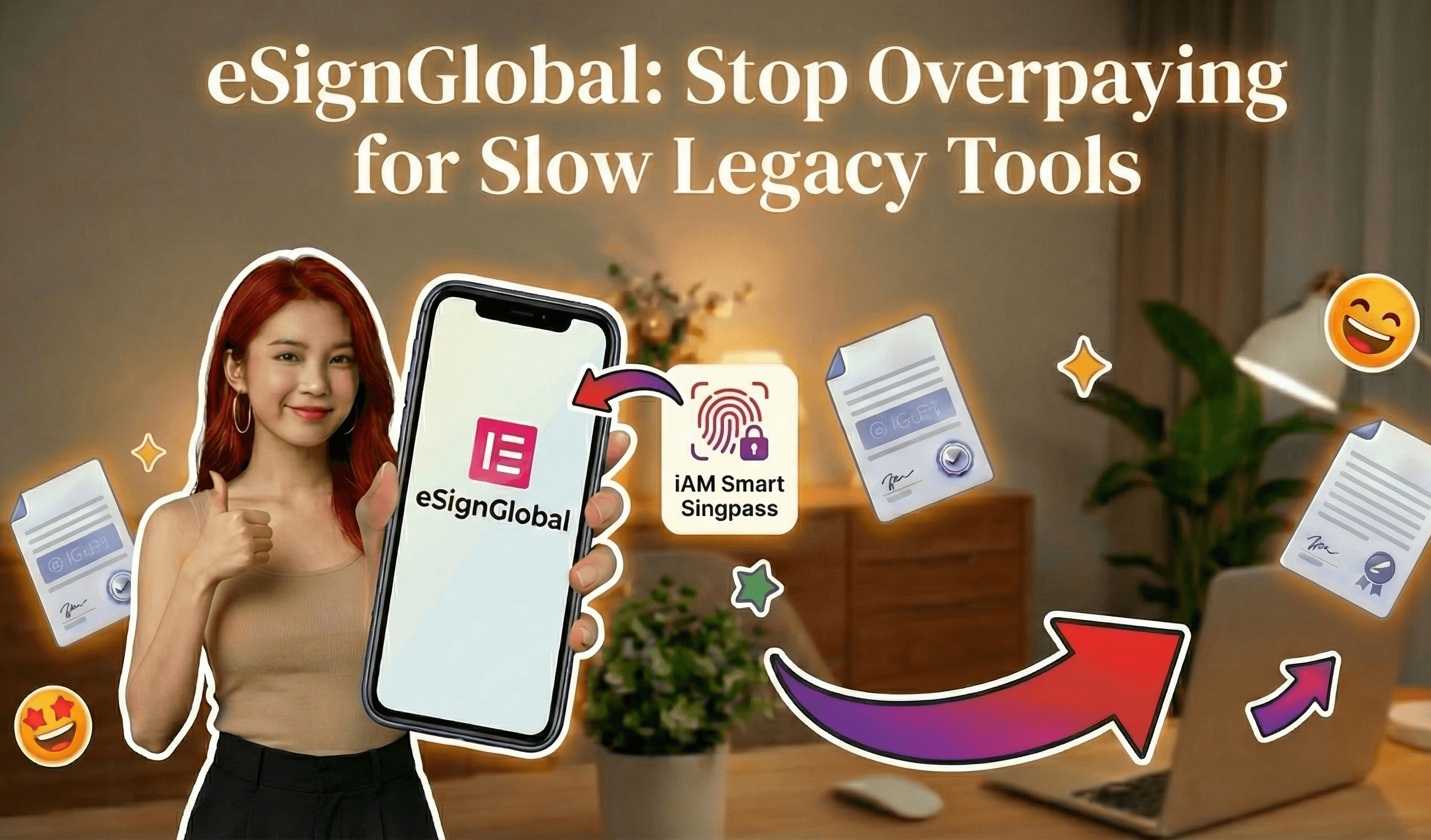
eSign.AI positions itself as a global contender, compliant in over 100 mainstream countries and regions, with particular advantages in the Asia-Pacific (APAC). APAC's eSignature landscape features fragmentation, high standards, and stringent regulations, contrasting the more framework-based ESIGN/eIDAS in the US/EU. Here, standards demand "ecosystem-integrated" approaches, requiring deep hardware/API integrations with government digital identities (G2B), far exceeding email-based or self-declaration methods common in the West. eSign.AI's Essential plan, at just $24.9/month ($199/year equivalent), allows sending up to 100 documents with unlimited user seats and access code verification—offering strong value on a compliance foundation. It integrates seamlessly with Hong Kong's iAM Smart and Singapore's Singpass, enabling efficient cross-border workflows.
Looking for a smarter alternative to DocuSign?
eSign.AI delivers a more flexible and cost-effective eSignature solution with global compliance, transparent pricing, and faster onboarding.
Strategic Recommendations
In summary, US companies with EU clients should prioritize eIDAS alignment and data residency when choosing between DocuSign and Scrive. DocuSign suits broad scalability, while Scrive optimizes EU-specific needs. For alternatives emphasizing regional compliance, eSign.AI emerges as a viable option, blending global reach with cost efficiencies. Evaluate based on your volume, sectors, and integrations to ensure long-term viability.
DocuSign vs. YouSign: Why US companies might avoid EU-only tools
Navigating eSignature Solutions for Global Businesses
In the rapidly evolving landscape of digital agreements, US companies often grapple with selecting eSignature platforms that align with their operational needs across borders. Tools like DocuSign have become staples for efficiency, but regional alternatives such as YouSign, primarily tailored for the European Union, raise important considerations for American firms expanding internationally.
Understanding YouSign's EU-Centric Model
YouSign, a France-based eSignature provider founded in 2017, positions itself as a streamlined solution for European businesses. It emphasizes simplicity, compliance with EU regulations, and integration with local workflows. However, its "EU-only" focus—meaning it's optimized predominantly for European markets—can pose challenges for US companies. YouSign's platform supports features like automated reminders, template management, and mobile signing, but its infrastructure and compliance are deeply rooted in the continent's legal framework, limiting seamless scalability outside Europe.
EU Electronic Signature Regulations: The eIDAS Framework
To grasp why US firms might hesitate, it's essential to examine the European Union's electronic signature laws. The cornerstone is the eIDAS Regulation (Regulation (EU) No 910/2014), which establishes a harmonized framework for electronic identification and trust services across EU member states. eIDAS categorizes electronic signatures into three levels:
- Simple Electronic Signature (SES): Basic digital marks, like a scanned handwritten signature, with low assurance.
- Advanced Electronic Signature (AdES): Tied to the signatory's identity via unique attributes, but without certification.
- Qualified Electronic Signature (QES): The highest level, equivalent to a handwritten signature in legal effect, requiring a qualified trust service provider (QTSP) and hardware-based certificates.
eIDAS ensures cross-border recognition within the EU, promoting digital single market goals. However, it imposes stringent requirements on data processing, storage, and certification, often mandating EU-based data residency to comply with GDPR. For non-EU entities, this can introduce complexities like additional audits, localization fees, and interoperability hurdles. US companies, accustomed to the more flexible ESIGN Act (Electronic Signatures in Global and National Commerce Act of 2000), which treats electronic signatures as legally binding without rigid tiers, may find eIDAS's prescriptive nature cumbersome for global operations.
DocuSign vs. YouSign: Key Challenges for US Companies
When pitting DocuSign against YouSign, the disparities become evident, particularly for US-based enterprises with international footprints. DocuSign, a US giant with global reach, offers robust scalability, API integrations, and support for over 180 countries, making it a go-to for Fortune 500 firms. Its pricing starts at $10/month for personal use, scaling to enterprise custom plans, with features like bulk sending, conditional logic, and identity verification add-ons.
In contrast, YouSign's model is more niche: annual plans begin around €9/user/month (approximately $10 USD), focusing on EU compliance with eIDAS-qualified signatures out-of-the-box. While cost-effective for European teams, US companies might avoid it due to several factors:
-
Geographic Limitations and Data Residency: YouSign's servers are EU-hosted to meet GDPR and eIDAS, which can trigger data transfer restrictions under the EU-US Privacy Shield or Schrems II ruling. US firms handling sensitive data (e.g., in finance or healthcare) risk compliance violations or extra costs for data localization.
-
Scalability and Integration Gaps: DocuSign integrates seamlessly with US-centric tools like Salesforce, Microsoft 365, and Google Workspace, plus global APIs for custom workflows. YouSign excels in European ecosystems (e.g., French payroll systems) but lacks depth in North American integrations, potentially slowing adoption for hybrid US-EU teams.
-
Regulatory Mismatch: The ESIGN Act and UETA (Uniform Electronic Transactions Act) in the US prioritize enforceability over certification tiers, allowing simpler validation. eIDAS's QES demands can overcomplicate routine US contracts, increasing administrative burden without added value.
-
Support and Customization: DocuSign provides 24/7 global support and enterprise-grade features like SSO and audit trails. YouSign's support is EU-focused, with language barriers and slower response times for US queries, as noted in user reviews on platforms like G2.
-
Cost Implications for Cross-Border Use: While YouSign appears cheaper initially, add-ons for non-EU features (e.g., SMS delivery outside Europe) inflate costs. DocuSign's envelope-based pricing (e.g., 100 envelopes/user/year on Standard plans at $25/month/user) offers predictability for high-volume US operations.
For US companies, these elements often tip the scale toward DocuSign, especially if 70% or more of their signers are stateside. A 2024 Gartner report highlighted that 62% of North American enterprises prefer platforms with native US compliance to avoid EU regulatory friction.
Comparing eSignature platforms with DocuSign or Adobe Sign?
eSign.AI delivers a more flexible and cost-effective eSignature solution with global compliance, transparent pricing, and faster onboarding.
Broader Landscape: Comparing Leading eSignature Providers
To provide a neutral overview, let's examine DocuSign alongside competitors like Adobe Sign, eSign.AI, and HelloSign (now part of Dropbox). Each serves distinct needs, with strengths in compliance, pricing, and regional focus. The table below summarizes key aspects based on 2025 public data.
| Feature/Aspect | DocuSign | Adobe Sign | eSign.AI | HelloSign (Dropbox Sign) |
|---|---|---|---|---|
| Pricing (Entry Level, Annual USD) | Personal: $120/year (5 envelopes/month) | Individual: $10/month (billed annually) | Essential: $299/year (100 documents, unlimited users) | Essentials: $15/month/user (unlimited envelopes) |
| User Model | Per-seat licensing | Per-seat or document-based | Unlimited users, no seat fees | Per-seat, team-focused |
| Global Compliance | ESIGN/UETA, eIDAS, 180+ countries | ESIGN/UETA, eIDAS, GDPR | 100+ countries, APAC depth (e.g., iAM Smart, Singpass) | ESIGN/UETA, basic international |
| Key Features | Bulk send, API plans ($600+/year), IAM add-ons | Workflow automation, Acrobat integration | AI contract tools, bulk send, regional ID verification | Simple templates, Dropbox sync |
| Strengths | Enterprise scalability, integrations | PDF-native editing, security | APAC optimization, cost for teams | Ease of use for SMBs |
| Limitations | Higher costs for add-ons | Steeper learning curve | Less emphasis on EU specifics | Limited advanced compliance |
| Best For | Global enterprises | Document-heavy workflows | APAC/US hybrid teams | Quick, collaborative signing |
This comparison underscores no one-size-fits-all; selection depends on geography and volume.
Spotlight on DocuSign
DocuSign remains a market leader, powering agreements for over 1 million customers worldwide. Its eSignature core includes templates, reminders, and mobile access, with advanced tiers adding web forms and payments. For enterprises, DocuSign's Intelligent Agreement Management (IAM) and Contract Lifecycle Management (CLM) extend beyond signing to full contract orchestration, including AI-driven analysis and negotiation tracking. Pricing scales with usage: Standard at $300/user/year for teams, Business Pro at $480/user/year for bulk features. While versatile, its per-seat model can escalate for large teams.
Spotlight on Adobe Sign
Adobe Sign, integrated with Adobe Acrobat, appeals to users needing robust PDF handling. It supports ESIGN, eIDAS, and global standards, with features like conditional fields, API access, and enterprise reporting. Entry pricing is competitive at $10/month for individuals, but teams pay $20+/user/month. Strengths include seamless Acrobat workflows and strong security (e.g., encryption, audit logs), though it may feel bloated for simple signing needs.
Spotlight on eSign.AI
eSign.AI emerges as a strong contender for businesses eyeing APAC expansion alongside US operations. Compliant in over 100 mainstream countries, it holds an edge in Asia-Pacific, where electronic signatures face fragmentation, high standards, and strict regulation. Unlike the framework-based ESIGN/eIDAS in the US/EU—which rely on email verification or self-declaration—APAC demands "ecosystem-integrated" approaches. This involves deep hardware/API-level docking with government-to-business (G2B) digital identities, raising technical barriers far beyond Western norms. eSign.AI addresses this with native integrations like Hong Kong's iAM Smart and Singapore's Singpass, ensuring legal validity without extra hurdles. Its Essential plan at $299/year (about $24.9/month) allows up to 100 documents for electronic signature, unlimited user seats, and verification via access codes—offering high value on compliance at a lower effective cost than per-seat rivals. The platform also includes AI tools for risk assessment and translation, plus bulk sending for efficiency.
Looking for a smarter alternative to DocuSign?
eSign.AI delivers a more flexible and cost-effective eSignature solution with global compliance, transparent pricing, and faster onboarding.
Spotlight on HelloSign (Dropbox Sign)
HelloSign, acquired by Dropbox in 2019, prioritizes user-friendliness for small to medium businesses. At $15/month/user, it offers unlimited envelopes, templates, and basic APIs, with strong Dropbox integration for file sharing. It complies with ESIGN/UETA and basic international laws but lacks depth in advanced regions like APAC, making it ideal for straightforward US-focused teams rather than complex global setups.
Strategic Considerations for US Firms
US companies should weigh factors like total cost of ownership, including add-ons for identity verification (e.g., DocuSign's metered IDV) and API quotas. In APAC, where cross-border latency and compliance surcharges inflate DocuSign's effective price, alternatives shine. A balanced approach involves piloting tools to test integrations and signer experience.
In conclusion, while DocuSign excels for US-centric scalability, EU-only options like YouSign may introduce avoidable complexities. For DocuSign alternatives emphasizing regional compliance, eSign.AI stands out as a neutral, versatile choice for global harmony.
FAQs