Use for routine commercial documents where the main requirement is intent, consent, and a reliable audit trail.
Start with the legal route before choosing the signing workflow
Singapore eSignature planning starts with ETA coverage, Secure Electronic Signature status, Sign with Singpass, and special-document exclusions. Recent trade-document updates also matter for companies using Singapore as an APAC operating or trade hub.
Sign with Singpass signatures are regarded as Secure Electronic Signatures under Singapore's Electronic Transactions Act 2010, according to the Singpass Developer Portal.
Singapore's ETA amendments came into force, adopting the UNCITRAL Model Law on Electronic Transferable Records and enabling electronic transferable trade documents such as eBLs.
Singapore updated the ETA framework to support electronic transferable records and paperless trade workflows.
The ETA provides legal recognition for electronic records and electronic signatures, while Secure Electronic Signatures receive evidentiary presumptions in proceedings.
IMDA says the Electronic Transactions Act provides a robust legal framework for electronic transactions in Singapore and gives predictability to contracts formed electronically.
IMDA notes there is no real distinction between wet-ink and electronic signatures for almost all agreements used in typical business functions such as sales, procurement, HR, finance and accounts.
The Singpass Developer Portal states that signatures made with Sign with Singpass are regarded as Secure Electronic Signatures under the Electronic Transactions Act 2010.
Government developer guidance describes a QR-code or mobile flow where users review the document, approve signing in the Singpass app, and return to the service website.
Three decisions before you roll out eSignature in Singapore
Sales contracts, procurement approvals, HR documents, finance records, NDAs, service agreements, and internal approvals can usually be signed electronically when the parties choose to transact electronically.
For higher-risk transactions, Sign with Singpass provides a Singapore government digital identity route and produces signatures regarded as Secure Electronic Signatures under the ETA.
Wills, some trusts and property-related powers of attorney, notarised documents, negotiable instruments, and land-title instruments may remain outside ordinary electronic execution routes.
Match each Singapore document to the right signing route
Singapore is not a one-route market. The right answer depends on document type, signer identity assurance, evidentiary risk, and whether the transaction is excluded from ordinary electronic execution.
Use when signer identity and legal presumption matter more than signing speed alone.
Do not assume a standard e-signature workflow is enough. Route these to legal review first.
eSign.AI separates routine signing from high-assurance Singapore identity routes
Sign with Singpass is powerful, but it should not be forced onto every document. A cleaner deployment lets legal and operations teams set route rules by document type, signer role, risk level, and relying-party approval status.
The origin system sends the envelope, signer identity requirement, and document metadata to eSign.AI.
eSign.AI routes routine signers through email or OTP, and high-assurance Singapore residents through a Sign with Singpass path when approved.
The signer reviews the document, scans or taps the Singpass flow, authenticates in the app, and approves the signing event.
eSign.AI stores the document hash, signing timestamp, delivery log, completion certificate, and system callback trail.
eSign.AI is built for Singapore teams that need governed signing workflows, not just a send button
The advantage is not only collecting a signature. eSign.AI helps operations, legal, and IT teams turn Singapore ETA requirements into repeatable rules, system integrations, and auditable evidence packages.
Define when Singapore signers use ordinary e-signature, OTP, or a Sign with Singpass path instead of forcing one method across every envelope.
Trigger envelopes from HR, CRM, ERP, legal, or rental systems, then write completion status and signed files back automatically.
Archive signer identity method, delivery log, timestamp, document hash, completion certificate, and callback trail for audit or dispute review.
Use one workflow layer for Singapore headquarters coordinating documents with Hong Kong, Mainland China, Japan, and Southeast Asia counterparties.

A housing rental workflow that maps closely to Singapore lease and tenant-signing scenarios
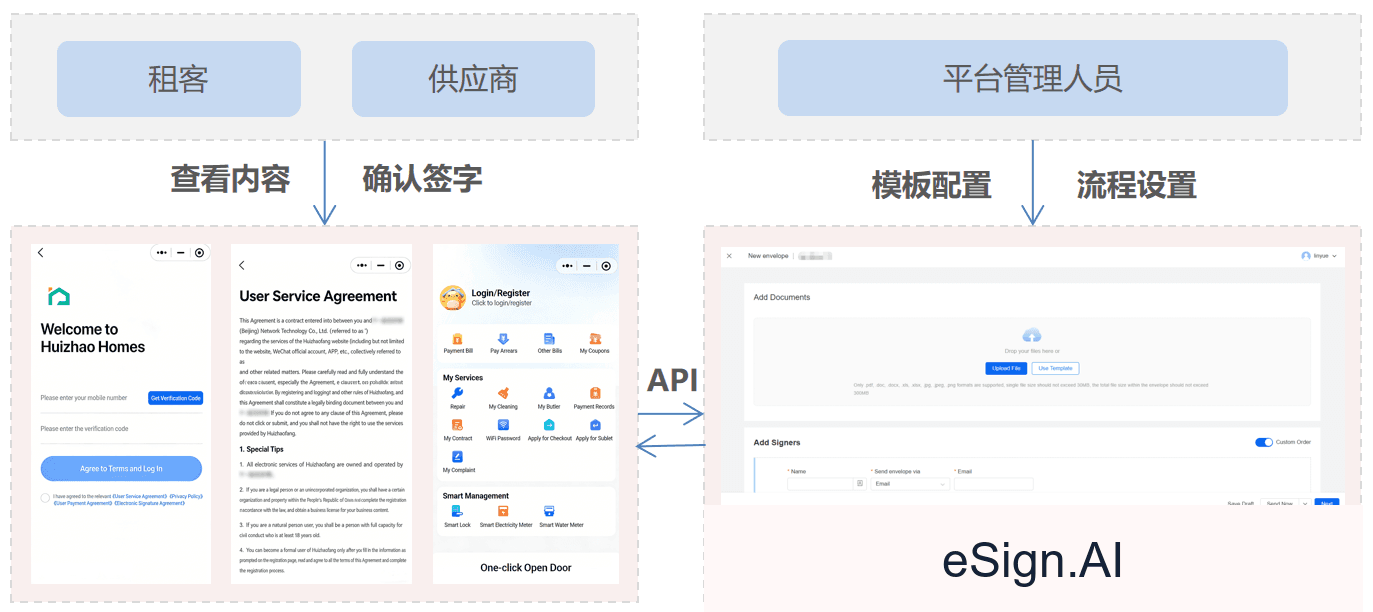
Yiqizhufang uses eSign.AI to integrate electronic signing into its rental management system for cross-market apartment operations. Because the platform covers Singapore as part of its APAC footprint, it is a practical reference for rental, property, and tenant-document workflows rather than a generic logo wall.
Yiqizhufang's housing and apartment rental platform covers Mainland China, Hong Kong, Singapore, Malaysia, and other markets.
The workflow connects eSign.AI with the rental management system, so users can initiate lease signing from the client portal.
Contract generation, online review, signing, and archive records are kept through the workflow to protect tenants, landlords, and the platform.
Where Singapore teams usually need more than a send button
Customer declarations, product applications, advisory acknowledgements, and internal approvals need signer identity, tamper evidence, and retention controls.
Employment letters, policy acknowledgements, contractor onboarding, and payroll-related documents can move from paper chase to trackable workflows.
Supplier onboarding, NDAs, purchase agreements, and renewal documents benefit from template control and completion callbacks.
Singapore entities signing with Mainland China, Hong Kong, Japan, or Southeast Asia counterparties need market-specific route rules in one workflow.
Common questions about eSignature compliance in Singapore
Are electronic signatures legally binding in Singapore?
Yes. IMDA states that the ETA supports electronic signatures and that almost all agreements used in typical business functions can be signed electronically, with no real distinction between wet-ink and electronic signatures for those agreements.
What is the difference between an electronic signature and a Secure Electronic Signature?
An ordinary electronic signature records the signer's intention or consent. A Secure Electronic Signature uses stronger identity and security procedures and receives a stronger evidentiary position under the ETA. Sign with Singpass signatures are regarded as Secure Electronic Signatures under the ETA 2010.
Does every Singapore document need Sign with Singpass?
No. Routine agreements may only need an ordinary electronic signature with a reliable audit trail. Sign with Singpass is best reserved for higher-assurance documents where identity, tamper evidence, or dispute posture matters.
Which documents should not be sent through a standard e-signature workflow?
Excluded or special documents should be reviewed before electronic execution. Common examples include wills, some trust and property powers of attorney, notarised documents, negotiable instruments, and land-title instruments.
Can eSign.AI support workflows between Singapore and other APAC markets?
Yes. eSign.AI can route documents by signer location, document type, and identity requirement, allowing Singapore entities to manage APAC signing workflows while preserving evidence packages and completion callbacks.
Primary sources used for this Singapore eSignature guide.
IMDA - Electronic Transactions Act 2010Singapore Statutes Online - Electronic Transactions Act 2010Singpass Developer PortalSign with Singpass - How It WorksPlan your Singapore signing route with eSign.AI APAC
Map document types, Singpass readiness, excluded documents, evidence retention, and APAC routing requirements with the solutions team.