


China is withdrawing an export rebate — and the EU is raising a gate on the same products
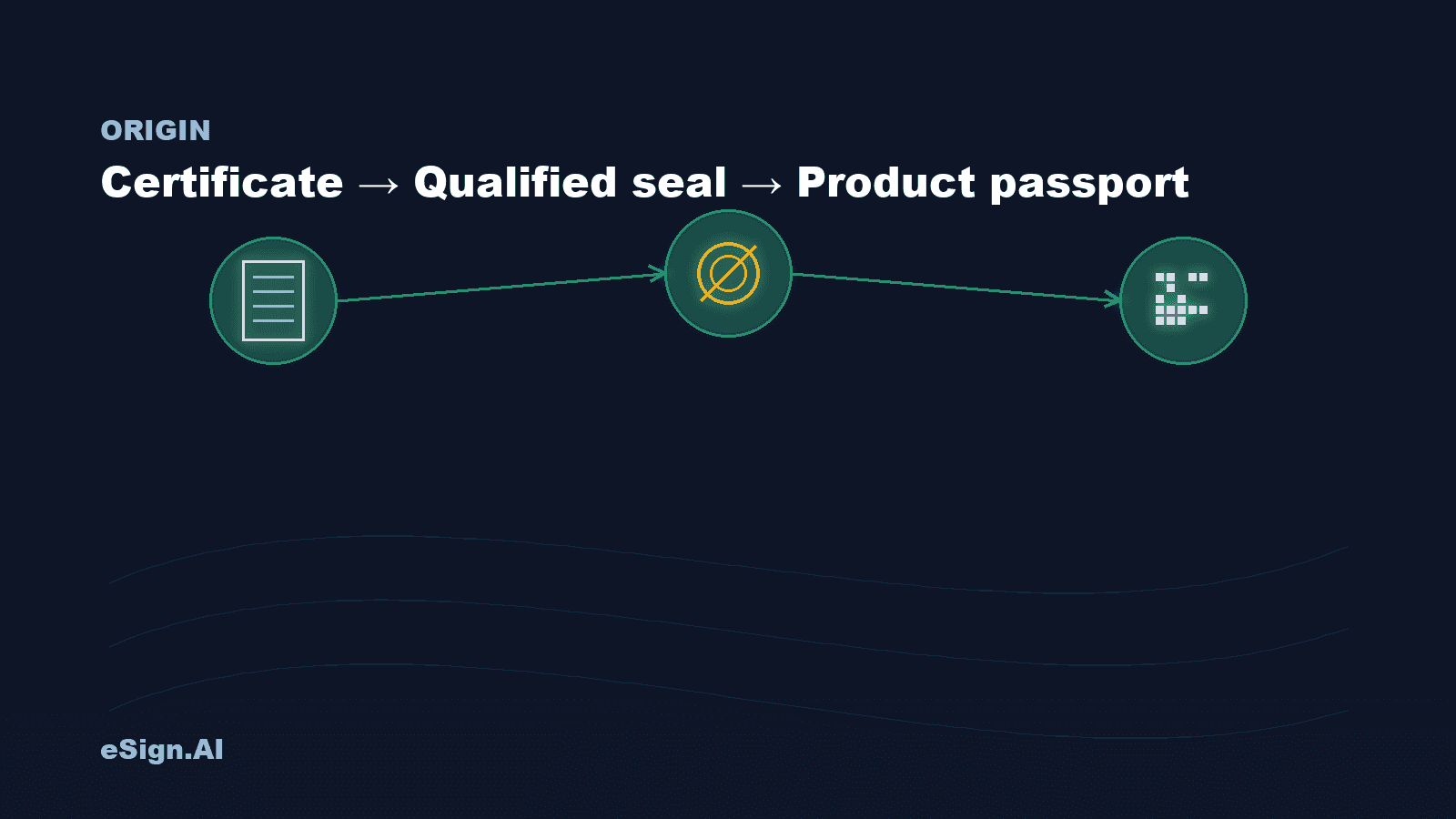
On 12 October 2026, China's Ministry of Finance and State Taxation Administration announced that the export tax rebate on new-energy vehicles will drop from 13% to 9%, effective 1 April 2027. Read on its own, it looks like a technical tweak. Read against the EU's rulebook, it is the clearest signal yet of a structural shift in EU-China trade: the era of competing on price is closing, and the era of competing on rules — and on trusted data — has opened. The two moves are not separate stories. They land on almost the same list of products. China is cutting rebates on batteries, new-energy vehicles and solar equipment; the EU is introducing Digital Product Passport obligations for batteries, textiles, electronics and other product groups — with the battery passport becoming mandatory on 18 February 2027. One side is withdrawing a price crutch; the other is raising a data gate. The access document that decides who keeps selling into Europe is what this article calls a passport: first the electronic Certificate of Origin (eCoC), later the Digital Product Passport (DPP).
NEV rebate cut
Effective
EU battery passport
EU anti-subsidy peak
Why now: a rebate series, not a one-off cut
The NEV change is the latest episode in a deliberate sequence. On 8 January 2026, China cancelled the export tax rebate for photovoltaic products and cut the battery rebate from 9% to 6%, with the battery rebate to be abolished from 1 January 2027. On 16 July 2026, it imposed a 2% consumption tax on batteries, rising to 4% on 1 September 2027. Then came the NEV cut of 12 October 2026. The direction is consistent: fiscal authorities no longer treat these industries as ones that need long-term subsidy. Rebates that once let exporters undercut competitors abroad — effectively exporting domestic subsidies into overseas price cuts — also invite anti-subsidy investigations. Cutting the rebate withdraws the ammunition of a price war and shifts the contest from who is cheaper to who stays compliant and keeps selling.
Three facts make the NEV rebate cut more than a tax story.
China's car exports are too big to ignore
China has overtaken Japan as the world's largest car exporter, and the pace has not slowed. At this scale, the marginal benefit of subsidising exports falls while the trade friction it triggers compounds.
Overseas barriers are becoming rule-shaped
The US, the EU, Canada and Türkiye all deploy tariffs and other tools against Chinese vehicles. The EU's approach is the most consequential because it stays inside the WTO framework — and has become a template others copy.
The export market has turned from blue ocean to red ocean
Chinese carmakers now fight each other abroad as well as at home. Handle it badly and the sector repeats the motorcycle and solar-panel story: market share won on price, given back in anti-dumping duties and collapsing margins.
Why focus on EU-China? Three structural turns
Overseas is not only Europe — the US, Canada and Türkiye all set barriers. The reason to use the EU as the clearest sample is a coincidence of product scope: the categories China is withdrawing rebates on are largely the same categories the EU is raising gates on. That overlap is what turns EU-China from a tariff-on-tariff spat into a full rules switch. Three turns define it.
The three turns, precisely
Each turn replaces an older lever of competition with a new one, and each depends on being able to prove something about the product.
From tariff confrontation to rule-based bargaining
The EU imposed countervailing duties on Chinese EVs (corporate rates of roughly 17.0% for BYD, 18.8% for Geely and 35.3% for SAIC). What matters more is the tool after the tariff: a minimum price undertaking (a price floor agreed with the European Commission that can reduce the duty) and an import quota for hybrids (quota volume set at half of sales, counted in units, not value). Both push the same way — forced price increases. The 1981 Japan-US auto agreement capped Japanese exports at 1.68 million units a year; Japanese makers responded by moving upmarket. History is repeating in another form.
From goods trade to rules-based access
Access used to be about product, price and channel. Increasingly, can it enter is bound to does it comply: origin, carbon footprint, data transparency, sustainability claims, traceability of compliance evidence. Product competitiveness is only the ticket in; rules capability decides whether you stay.
From price advantage to compliance capability
When low prices are no longer allowed or no longer pay, the core competence has to move from cost to compliance and technology. Whoever turns compliance into infrastructure — rather than a pile of documents assembled before shipping — protects margin and share through the price-increase cycle.
The watershed: who turns rules into a passport
The conclusion is already visible: the EU is embedding trade ever more deeply in its own rule system. For Chinese exporters, compliance has moved from a cost line to a strategy line, and its landing point is a set of passports that can be trusted and issued at scale. They arrive in two waves. The first wave is already in use: the electronic Certificate of Origin (eCoC), serving the automotive industry. The second wave is arriving: the Digital Product Passport (DPP), covering the wider set of general industries. The first is the identity card for tariff treatment and customs clearance; the second is a product-data passport that becomes mandatory from 2027.
First passport: making origin trusted data (eCoC)
For the automotive industry, the Certificate of Origin is the passport that matters most right now — because every tool in play (countervailing duty, import quota, minimum price undertaking) rests on the same finding: is this product really of Chinese origin? A Certificate of Origin (CO) is the core document by which goods claim tariff treatment, apply origin rules and clear customs. As trade tools become more rule-shaped, being able to issue a CO credibly, quickly and at scale is itself a hard capability. The traditional process is off-line: paper forms, manual submission, document-by-document review — slow, hard to trace, hard to scale, and a bottleneck the moment a carmaker must file thousands of compliance documents a year. The electronic Certificate of Origin (eCoC) digitises this passport. The core action: a structured XML certificate carrying certification data is sealed with a Qualified Electronic Seal and delivered directly to the relevant body (chamber of commerce, customs or regulator) — verifiable, evidential and batch-capable throughout. There is one institutional precondition that decides success: the EU has institutionalised trust. Under eIDAS, only a Qualified Electronic Seal (QSeal) issued by a Qualified Trust Service Provider (QTSP) on the EU Trust List carries the presumption of data integrity and origin, and is recognised directly by EU customs, regulators and business partners. A domestic signing service a company already uses may not map to that qualified level — this is not a capability gap but a scope-of-recognition gap. In practice the difference is measurable. A Chinese carmaker exporting to Europe used to take about 7 days to sign and issue an eCoC; after connecting automated signing, that fell to about 1 day.
Second passport: the Digital Product Passport (DPP)
If eCoC answers can this certificate be trusted, DPP answers can the data across this product's whole life cycle be trusted. Introduced by the EU's Ecodesign for Sustainable Products Regulation (ESPR, Regulation (EU) 2024/1781), the DPP is a product-level digital record linking a physical product to structured information via a data carrier such as a QR code, open to consumers, importers, distributors, recyclers, market-surveillance authorities and customs. The key insight: the QR code is only the entrance; the real obligation is the data governance behind it — unique identifiers, governed product data, access rights, reliable hosting, security controls, and data that stays available for the required period. Generating a QR code takes minutes; building an accurate, long-maintained product data chain across suppliers, factories and systems takes far longer. Timeline: under the Batteries Regulation (Regulation (EU) 2023/1542), from 18 February 2027 every EV battery, industrial battery above 2 kWh and light-means-of-transport battery placed on the EU market must carry an electronic battery passport. Batteries are only the start — under the ESPR 2025–2030 working plan, textiles, steel, aluminium, tyres, furniture, electronics and energy-related products are among the next priorities, and China is a major supplier of these categories to the EU.
Two product lines — each serving a different industry
eSign.AI offers two parallel product lines: the eCoC electronic Certificate of Origin serves the automotive industry, and the Digital Product Passport serves the wider set of general industries. Each line is built for a different industry and a different stage of market access, while both rest on the same digital-trust and sealing infrastructure. Product line one — eCoC (automotive industry). Core flow: a manufacturer uploads a structured XML certificate carrying certification data; the system applies a Qualified Electronic Seal (QSeal); the sealed certificate is delivered to the relevant body (chamber of commerce / customs / regulator) — verifiable, evidential and batch-capable. Technical foundation: QSeal applied through eSign.AI's Registration Authority (RA) service, connected to the EU Trust List QTSP ANF AC; eIDAS presumption of integrity and origin; SaaS / SDK / API with batch APIs and templates, integrated with ERP (product master data), PLM (specifications) and MES (production data). Reported result: a Chinese carmaker exporting to Europe cut eCoC signing and issuance from about 7 days to about 1 day by connecting automated signing. Product line two — DPP (general industries). It runs on two tracks. Track one, verifying the economic operator: RA service plus the EU Trust List QTSP ANF AC support QSeal application and delivery, guiding non-EU manufacturers through identity verification, certificate-information checks and the organisation-seal step required to onboard the register. Track two, signing product and compliance data: PDF via PAdES, structured XML / JSON via XAdES / JAdES long-term signatures, with qualified timestamps and evidence retention; SaaS / SDK / API and batch submission likewise. Shared foundation: trusted sealing (QSeal), structured-data handling, system integration (ERP / PLM / MES) and evidence retention. One digital-trust and sealing infrastructure supports eCoC on one side and DPP on the other; the specific product data and legal requirements are governed by each compliance regime.
Frequently asked questions
Largely, yes. China is scaling back or cancelling rebates on batteries, new-energy vehicles and solar equipment; the EU's first DPP waves cover batteries (mandatory 18 February 2027), then textiles, steel, aluminium, tyres, furniture, electronics and energy-related products. The two lists overlap substantially, so exporters in these categories often have to manage the rebate phase-down and the DPP obligation at the same time.


