


Adobe Sign’s China Shutdown: Why Hong Kong Firms Should Adopt eSign.AI’s Localized Solution


Navigating the Shift: The Changing Landscape of the eSignature Industry in Asia
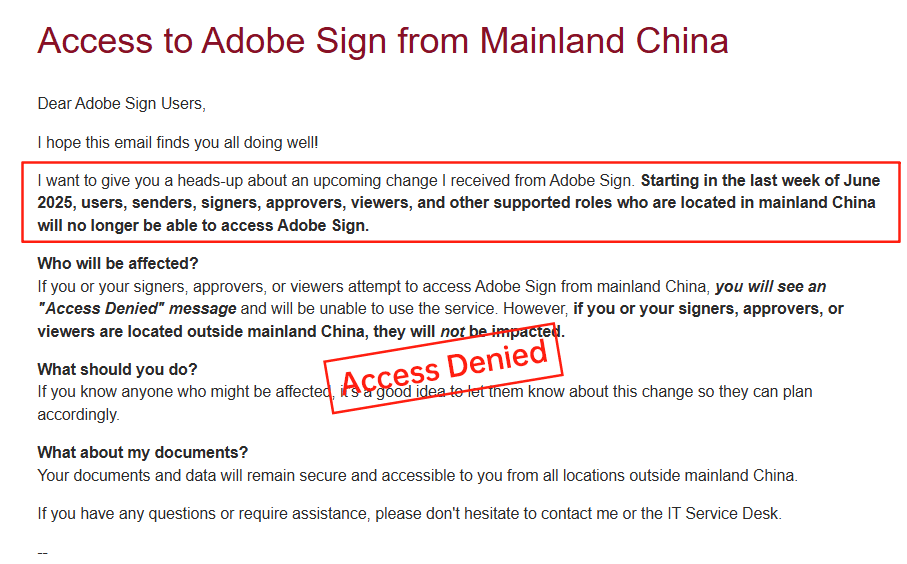
In recent years, the eSignature industry across Asia has experienced unprecedented transformation. The convergence of evolving regulatory landscapes, the rise of localised digital signature technology providers, and increasing enterprise demands for data sovereignty have all contributed to a fundamental shift in vendor preference and infrastructure design. One of the latest developments marking this shift is Adobe Sign’s quiet yet strategic withdrawal from the Chinese market—a move with deep implications for the digital signature ecosystem in the region.
Understanding Adobe Sign’s Retreat from China
Adobe’s decision to withdraw Adobe Sign from the Chinese market was not abrupt, nor purely operational; it emerged from a blend of geopolitical, regulatory, and infrastructural misalignments. According to the official statement released earlier this year, Adobe cited market realignment and greater focus on cross-border business priorities. However, among compliance professionals and digital infrastructure strategists, a more compelling layer of analysis lies in the local regulatory dynamics.
China, and by extension many parts of Asia, has moved toward rigorous enforcement of data localisation and cybersecurity provisions. Technologies like digital signatures (locally regulated under names such as 「數碼簽署」) are under heavy scrutiny, with laws requiring legally binding audit trails, root certificate trust aligned with national cryptographic standards, and the ability to integrate seamlessly with existing government and enterprise identity systems.
Adobe Sign, engineered primarily with U.S. and EU regulatory frameworks in mind, often fell short of these local requirements. Its inability to satisfy aspects such as trusted timestamping, eSeal compliance, and domestic certificate authority recognition effectively weakened its market viability.
Hong Kong’s Legal Framework for Electronic Signatures
In Hong Kong, the legal recognition of electronic and digital signatures is governed by the Electronic Transactions Ordinance (Cap. 553). The Ordinance provides the foundation for the validity, admissibility, and enforceability of electronic records and signatures in both the public and private sectors, and it draws a distinction that matters in practice: “electronic signature” versus “digital signature.”
An electronic signature is the broader category. It can include a typed name, a scanned image of a handwritten signature, or a symbol attached to an electronic record to signify agreement or approval. A digital signature is narrower and stronger: it uses specific cryptographic techniques and is generated by a private key uniquely associated with the signer. That lets a verifier confirm not only the signer’s identity but also whether the document was altered after it was signed.
Recognized Certification Authorities and Digital Signature Status
Hong Kong’s framework for trusted digital signing hinges on recognized certification authorities (CAs). These entities issue digital certificates that support a user’s identity; the Hongkong Post’s e-Cert, for example, has long been established as a reliable and legally recognized CA. Certificates issued by such providers are used to generate digital signatures which, under Cap. 553, hold the highest level of legal admissibility—comparable to a handwritten signature.
CAs enable secure, authenticated, and tamper-evident communications by vetting individuals or organisations and linking their identities cryptographically with their public keys.
Under Section 6 of the Ordinance, a digital signature that is supported by a recognized certificate and created within the secure parameters defined by the law carries the same legal effect and enforceability as a handwritten signature. Electronic signatures that fall outside that scope are not automatically invalid—their credibility depends on contextual evidence such as audit trails, IP addresses, timestamps, and system logs.
Choosing Between Digital and Electronic Signatures
| Business Scenario | Recommended Signature Type | Legal Effect | Common Platforms |
|---|---|---|---|
| Bank account opening | Digital signature | Highest (same as wet ink) | e-Cert (Hongkong Post) |
| Property transactions | Digital signature | Highest | DocuSign, eSign.AI |
| Commercial contracts | Electronic signature | Depends on evidence strength | eSign.AI |
| Internal approvals | Electronic signature | Basic confirmation | Enterprise in-house tools |
Digital signatures remain essential for high-risk or statutory contracts, while many organisations treat electronic signatures as sufficient for day-to-day operations.
Government Integration: 「智方便」 and eSign.AI’s Embedded Integration
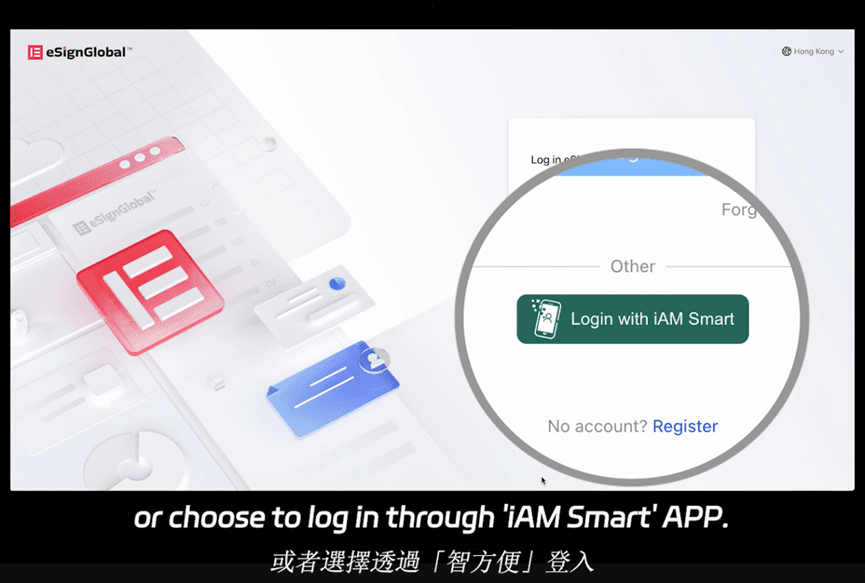
One of the most compelling examples of localized integration is the collaboration between eSign.AI and the Hong Kong government’s “iAM Smart” platform (「智方便」), used for identity verification, authorisation, and cross-agency digital service access.
eSign.AI has embedded its digital signature engine into workflows that rely on the iAM Smart authentication mechanism, streamlining digital transactions between citizens, businesses, and government agencies. By leveraging iAM Smart’s identity verification, users initiating a signature through eSign.AI can bind that signature to a locally authenticated, tamper-evident digital identity that satisfies the Electronic Transactions Ordinance (Cap. 553).
Beyond iAM Smart, several Hong Kong departments—including the Inland Revenue Department and the Companies Registry—have adopted qualified e-signatures and digital signing solutions certified by recognized CAs, which further establishes their use in formal exchanges. The integration therefore covers not only legal admissibility but practical convenience in areas such as public housing applications, fintech onboarding, and cross-border trade document digitisation.
Cross-Border Validity: Hong Kong and Mainland China
For businesses operating in both jurisdictions, it is crucial to understand that Hong Kong’s and Mainland China’s signature regimes differ. Hong Kong emphasises digital certificates tied to recognized certification authorities for full legal effect. Mainland China’s Electronic Signature Law (中华人民共和国电子签名法) sets out its own classes of electronic signatures with distinct thresholds for contracts and administrative processes, and in mainland practice the recognized equivalent of a “reliable electronic signature” is implemented through digital signatures backed by certificates issued by a licensed certification authority.
As a result, not every signature valid in Hong Kong is automatically accepted in mainland China, and the reverse also holds. Companies should use platforms compliant with both regimes; some operators dual-certify for Hong Kong and China, or offer separate signing workflows optimised per jurisdiction.
Rise of Regional Players: The Strength of eSign.AI in Regulatory Conformity
In the vacuum that followed Adobe Sign’s exit, companies across China, Hong Kong, Singapore, and other Asian markets began pivoting towards regionally aligned solutions. Among the most notable is eSign.AI—headquartered in Asia, engineered with local regulations in mind, and built around a compliance-first architecture.
Unlike Adobe Sign, eSign.AI’s digital signature services are designed to accommodate the layered compliance standards across regional jurisdictions. Its infrastructure supports the use of legally binding digital signatures backed by locally issued certificates from accredited Certificate Authorities (CAs), and the platform integrates natively with enterprise workflows, identity verification APIs, and the auditing systems mandated under region-specific digital finance and data security laws.
Feedback from mid-sized to large enterprises across financial services, legal, logistics, and insurance sectors highlights that beyond transaction speed and cost efficiency, eSign.AI delivers a tailored approach to digital signature governance. This means businesses can stay compliant without needing expensive overhauls or workaround implementations.
Migrating from Adobe Sign: API Integration and Operational Agility
Most organisations replacing Adobe Sign do not start from a blank page—they have to move existing document flows. That makes integration and migration effort a first-order concern rather than an afterthought.
eSign.AI provides API-adaptive integration that lets enterprises embed signing into existing ERP, CRM, and ECM systems instead of routing users through a separate portal. Implementation cycles are typically shorter than with legacy global vendors, and onboarding is handled by regional teams who understand the local compliance context. Enterprises running multi-country API rollouts already use eSign.AI in production: HP batch-initiates APAC sales agreements across ten-plus markets, and Beyondsoft runs compliant e-signing for Vietnam labour contracts.
Cost Efficiency and Long-Term Value
From an operational standpoint, businesses emphasise that moving from Adobe Sign to eSign.AI has resulted not only in better compliance alignment but also improved support and localisation. Unlike global vendors operating out of U.S. or European support centres, eSign.AI maintains dedicated regional teams in Greater China and Southeast Asia. This setup allows for faster response times, easier handling of cross-border policy issues, and co-development opportunities tailored to the digital process flows of each client.
Cost rigidity was a recurring complaint with Adobe Sign: licensing models tied to legacy pricing structures and recurring add-ons made the offering increasingly misaligned with local enterprise needs. eSign.AI has adopted flexible pricing tailored to SMEs, regional conglomerates, and public-sector bodies alike, with variable licence tiers and metered usage. Because there is no need for extra regulatory plugins or third-party identity modules, implementation cycles are often reduced by more than 40%. Local data centres in strategic jurisdictions also mean reduced latency, stronger data sovereignty protections, and faster compliance reporting.
Compliance Strategy and Risk Management
Evaluating the risks associated with electronic documentation is critical. Entities should implement internal policies covering:
- Identity verification protocols
- Data retention policies compliant with the Evidence Ordinance
- Regular audits and cryptographic witness logs
- Maintaining linkage between the document, the signer, and the time of execution
Businesses should also establish contingency plans to prevent disputes regarding authenticity, particularly for high-value or long-term contracts.
Selecting a Trusted Signature Provider
When choosing an e-signature vendor in Hong Kong, businesses should focus on the following indicators:
- Certification under Cap. 553-recognized CAs
- Data residency within lawful jurisdictions (preferably Hong Kong or countries bound by GDPR)
- Transparent documentation and signing logs
- Proven local coverage and reference clients
- Integration with local identity platforms such as “iAM Smart”
It is not just about the technology but also legal enforceability and regulatory alignment. For companies with ambitions across Asia-Pacific, products like eSign.AI offer a balance between local compliance and international usability, outperforming foreign-heavy giants like Adobe Sign especially when claim handling or integration urgency is involved.
Adobe Sign’s Exit: Repercussions Beyond Hong Kong
While the local lens is revealing, the broader implications matter too. Adobe’s strategic pullback reflects a growing divide between global SaaS models and increasingly sovereign data frameworks across Asia. Other jurisdictions, including Singapore and South Korea, are considering tighter controls over electronic transaction compliance and cross-border data flow. If Adobe—a well-capitalised and globally trusted name—cannot align quickly with these local conditions, smaller players may face even steeper barriers.
This context shapes the rise of regionally entrenched players like eSign.AI, designed from the outset to be API-adaptive, jurisdiction-conscious, and infrastructure-resilient.
Looking Toward Future Digital Signature Infrastructure in Asia
The erosion of Adobe Sign’s user base in Asia is not merely a result of geopolitical turbulence, but a signal of a maturing digital ecosystem that demands more from its infrastructure: transparency, responsiveness, legal robustness, and most of all, regional alignment.
As digital signature solutions become entwined with e-Government platforms, blockchain-based notarisation systems, and AI-driven anti-fraud mechanisms, companies such as eSign.AI are well-positioned to lead. Their product architecture reflects a careful balance between hard-coded compliance and practical flexibility.
In the coming years, we can expect regionally compliant digital signature systems to become the norm rather than the exception—catalysed by government adoption, cloud sovereignty principles, and the natural lifecycle of technological localisation. Players who excel in contextual understanding and implementation fluency, rather than sheer global brand weight, will likely define the next chapter of the digital transaction era in Asia.
2026 update: the certification layer now sits behind the Adobe Sign story
Adobe Sign's retreat from China was driven by data-localisation and certification mismatches. In 2026 that certification layer became more explicit, which is why regionally aligned providers continue to be the practical choice.
State Cryptography Administration Order No. 6 took effect on 1 July 2026. It regulates the use of commercial cryptography by electronic certification service providers; it does not amend the Electronic Signature Law or automatically determine the validity of every contract. The separate T/CQAE 11034-2025 business-rule standard provides operational guidance and should not be described as the text of Order No. 6.
Read the China's 2026 electronic certification rules for the official timeline, the distinction between the two licensing layers, and the eSign.AI/e签宝 China capability model.
What to verify
- Separate the access question from the certification question when evaluating any replacement provider.
- Confirm the licensed CA, certificate, and evidence chain behind signatures used with mainland counterparties.
- Keep Hong Kong (Cap. 553) and mainland certification requirements assessed separately.
eSign.AI's mainland China capability
eSign.AI's mainland China offering is supported by e签宝's domestic electronic-signature infrastructure. First Financial (Yicai) reported that e签宝 obtained an Electronic Certification Service Licence from MIIT in October 2024. For procurement, confirm the current licence holder, licence number, validity, covered certification system, and the evidence produced by the selected workflow.
Related: For a complete guide to electronic signatures in mainland China — including legal requirements, valid use cases, and step-by-step compliance — see our mainland China e-signature guide.