'%3e%3cpath%20fill-rule='evenodd'%20clip-rule='evenodd'%20d='M6.99935%2012.8327C10.221%2012.8327%2012.8327%2010.221%2012.8327%206.99935C12.8327%203.77769%2010.221%201.16602%206.99935%201.16602C3.77769%201.16602%201.16602%203.77769%201.16602%206.99935C1.16602%2010.221%203.77769%2012.8327%206.99935%2012.8327Z'%20stroke='%23666666'%20stroke-linecap='round'%20stroke-linejoin='round'/%3e%3cpath%20d='M1.16602%207H12.8327'%20stroke='%23666666'%20stroke-linecap='round'%20stroke-linejoin='round'/%3e%3cpath%20fill-rule='evenodd'%20clip-rule='evenodd'%20d='M6.99935%2012.8327C8.28802%2012.8327%209.33268%2010.221%209.33268%206.99935C9.33268%203.77769%208.28802%201.16602%206.99935%201.16602C5.71068%201.16602%204.66602%203.77769%204.66602%206.99935C4.66602%2010.221%205.71068%2012.8327%206.99935%2012.8327Z'%20stroke='%23666666'%20stroke-linecap='round'%20stroke-linejoin='round'/%3e%3cpath%20d='M2.875%202.95898C3.93063%204.01461%205.38896%204.66754%206.99978%204.66754C8.61062%204.66754%2010.069%204.01461%2011.1246%202.95898'%20stroke='%23666666'%20stroke-linecap='round'%20stroke-linejoin='round'/%3e%3cpath%20d='M11.1246%2011.0425C10.069%209.98691%208.61062%209.33398%206.99978%209.33398C5.38896%209.33398%203.93063%209.98691%202.875%2011.0425'%20stroke='%23666666'%20stroke-linecap='round'%20stroke-linejoin='round'/%3e%3c/g%3e%3cdefs%3e%3cclipPath%20id='clip0_1267_9109'%3e%3crect%20width='14'%20height='14'%20fill='white'/%3e%3c/clipPath%3e%3c/defs%3e%3c/svg%3e)
Electronic contract — Civil Code Article 469
A contract may be concluded in written form, including data messages such as electronic data interchange and email, provided the content can be tangibly presented and accessed for reference at any time.




China Mainland · CA Digital Signature · Electronic Signature Law
A reliable electronic signature in China is a CA-based digital signature. Under Article 14, it carries the same legal effect as a handwritten signature when the four conditions in Article 13 are met.
The basics
China's Civil Code and Electronic Signature Law give electronic contracts and signatures the same standing as paper, as long as the content can be displayed and retrieved and the signature meets the reliability conditions.
A contract may be concluded in written form, including data messages such as electronic data interchange and email, provided the content can be tangibly presented and accessed for reference at any time.
An electronic signature is data in electronic form attached to or logically associated with a data message, used to identify the signer and to indicate the signer's approval of its content.
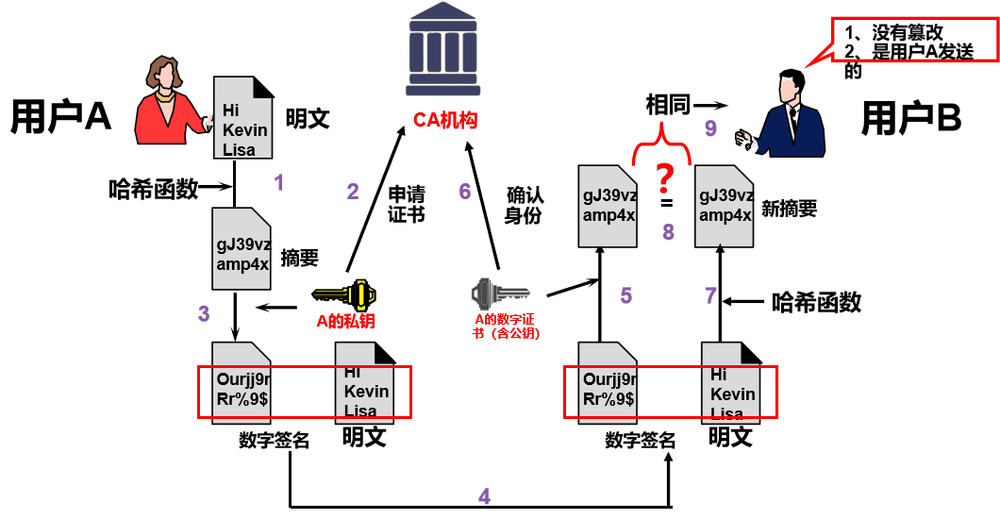
In China, a reliable electronic signature is implemented as a CA-based digital signature: a certificate issued by an MIIT-licensed Electronic Certification Service provider, with asymmetric cryptography binding identity and protecting integrity.
Official legal baseline
How it works
From real-name identity verification to a retrievable evidence package, a compliant signing flow follows four steps.
Verify each signer's identity — individuals by ID and mobile, enterprises by business license. Under the 2026 rules, verification must be done directly by the CA.
Build the contract from a reusable template with predefined signature, seal, and date fields, keeping terms consistent and reducing errors.
Apply the CA-based digital signature with the signer's certificate, a document hash, and a trusted timestamp.
Retain the signed document with identity records, signing events, integrity records, and the certificate chain — retrievable for audit or dispute.
Legal definition
Article 13 of the Electronic Signature Law lists four cumulative conditions. A signature that meets all four carries the same legal effect as a handwritten signature or seal.
When used, the signature creation data belongs solely to the signer and stays under the signer's exclusive control. Under the 2026 rules, if a platform or CA custodies the private key, it must obtain separate written authorization specifying scope, scenarios, duration, and access logs.
After signing, any alteration to the electronic signature can be detected; the evidence workflow retains full integrity records.
The signed data message and its integrity evidence are preserved in full; any change to content or form can be detected.
Article 3 excludes documents on personal relationships (marriage, adoption, inheritance) and certain public-utility documents; the former real-estate exclusion was deleted in 2019. Identify and isolate these at classification.
Data storage
China filings often require the file to stay retrievable and, for some groups, inside a defined boundary. Pick the deployment shape before you scale.
| Deployment | Where files live | Best for | What to confirm |
|---|---|---|---|
| Public cloud (SaaS) | On the provider’s cloud, in the region you select. | Fastest rollout; no infrastructure to run. | Data residency, access control, and retention terms. |
| Dedicated cloud | Isolated cloud resources used only by your tenant. | Regulated teams that need separation but not self-hosting. | Tenant isolation, audit logs, and the service SLA. |
| On-premise deployment | Inside your own network; files do not leave it. | Groups that cannot let contract files leave their environment. | Deployment fee, operations, and custom integration work. |
Public cloud (SaaS)
On the provider’s cloud, in the region you select.
Fastest rollout; no infrastructure to run.
Data residency, access control, and retention terms.
Dedicated cloud
Isolated cloud resources used only by your tenant.
Regulated teams that need separation but not self-hosting.
Tenant isolation, audit logs, and the service SLA.
On-premise deployment
Inside your own network; files do not leave it.
Groups that cannot let contract files leave their environment.
Deployment fee, operations, and custom integration work.
Cost structure
Total cost has three parts. eSign.AI does not charge seat fees — you pay per envelope, tiered by volume, with optional versions for advanced workflows.
Volume-tiered: the more envelopes your team sends, the lower the unit price. Signers never need an account or a subscription to sign.
API integration, bulk send, and contract management are licensed by version and billed annually, on top of the signing volume.
Audit trails, retention, and attestation are part of the platform. On-premise deployments add infrastructure, operations, and custom work.
Regulatory update · 2026
The updated Measures for the Administration of Electronic Certification Services and T/CQAE 11034-2025 tighten requirements across four areas.
Identity verification must be performed directly by the licensed CA — not delegated to external agencies.
The certification agreement must be signed directly between the CA and the subscriber. Default checkboxes and platform-only agreements no longer meet the standard.
Certificate issuance and signing actions must leave a complete evidence trail. Higher-assurance certificates may require audio or video records.
Private keys belong to the user. If custodied by a platform or CA, separate written authorization is required.
eSign.AI product capabilities
eSign.AI gives legal, HR, and operations teams the tools to run compliant electronic signing at scale in China.
Verify individuals and enterprises, and connect identity providers and business systems through built-in integrations.

Build reusable templates with signature, seal, date, and text fields; map them to CSV or API variables; share controlled template libraries across teams.
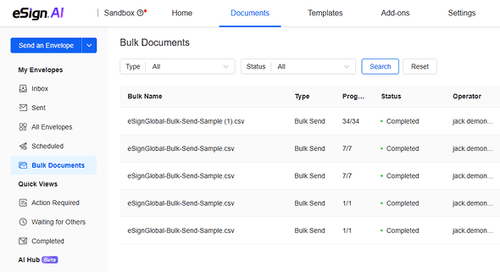
Send to 1,000+ recipients from a CSV with unique signing links and live signing-status tracking — built for HR onboarding and supplier agreements.
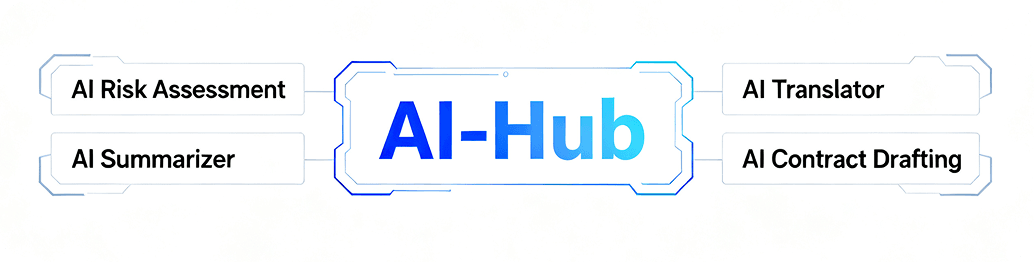
The AI Hub flags high-risk clauses, summarizes long contracts, and supports pre-signing compliance checks.
Evidence and admissibility
Chinese courts assess electronic evidence by how records were generated, stored, and transmitted. A complete, tamper-evident evidence package supports admissibility.
Each signed document is sealed with a document hash and a trusted timestamp, with identity records, signing-intent evidence, and signing events retained as a verifiable package. Under the 2026 rules, the evidence chain must demonstrate CA-direct verification, subscriber-level agreement, and complete intent records.
Evidence can be preserved with timestamp authorities and blockchain-based notarization, and an evidence report can be produced for court or arbitration.
The completed document, signer identity, verification method, integrity records, and certificate context remain retrievable for audit and dispute review.
The provider should hold an MIIT CA license and meet commercial cryptography and Multi-Level Protection Scheme (MLPS) requirements.
Legal timeline
A mature framework does not mean every document uses the same signing path — execution decisions remain document-specific.
Established data messages, reliable electronic signatures, and electronic certification services, with Article 14 granting equal legal effect.
Revised provisions in line with the developing electronic commerce environment.
The 2019 amendment is the current official text of the Electronic Signature Law.
Article 469 reinforced data messages as a valid written form, strengthening the standing of electronic contracts.
Hangzhou Tiangu Information Technology Co., Ltd. (eSign.AI's parent organization) obtained the MIIT Electronic Certification Service License, establishing a self-owned CA capability for the domestic market.
The industry standard T/CQAE 11034-2025 and updated Measures for the Administration of Electronic Certification Services were released, signaling a shift toward stricter CA compliance.
Stricter enforcement begins for CA direct verification, direct signing, intent-evidence retention, and private-key management. Enterprises should review provider compliance and existing contract workflows.
Deployment scenarios
From HR onboarding to cross-border agreements, document-specific routing and evidence retention power high-frequency signing across industries.
Employment contracts, policy acknowledgements and onboarding documents run on reusable templates with controlled access and complete signing records.
Sales contracts, NDAs, supplier onboarding and renewals with signer-authority checks and completion callbacks to the system of record.
Loan agreements, account opening, investment confirmations and compliance disclosures signed with full audit trails and evidence packages.
Purchase orders, quality acceptance certificates, logistics receipts and supplier contracts standardised across plants and partners.
ERP, CRM, HR, OA and procurement systems trigger signing via API; evidence packages return to the originating system on completion.
Mainland entities coordinating with Hong Kong, Singapore and overseas affiliates route by document type and signer location.
Customer stories
How leading China-based enterprises standardize signing across HR, supply, and operations.

eSign.AI standardizes contract signing across Winner Medical's manufacturing and supply operations, with reusable templates and complete signing records.

eSign.AI helps Green Tea Group manage signing for its directly operated stores across multiple regions at lower cost.

eSign.AI standardizes signing for Mixue's franchise recruitment, procurement, and supply cooperation across multiple countries.
Get a configuration walkthrough covering real-name verification, template setup, evidence retention, and system integration.
FAQ
China workflow review
Bring your document types, signer roles, existing systems, and evidence requirements into a China signing workflow review. eSign.AI's team can walk through the configuration.