


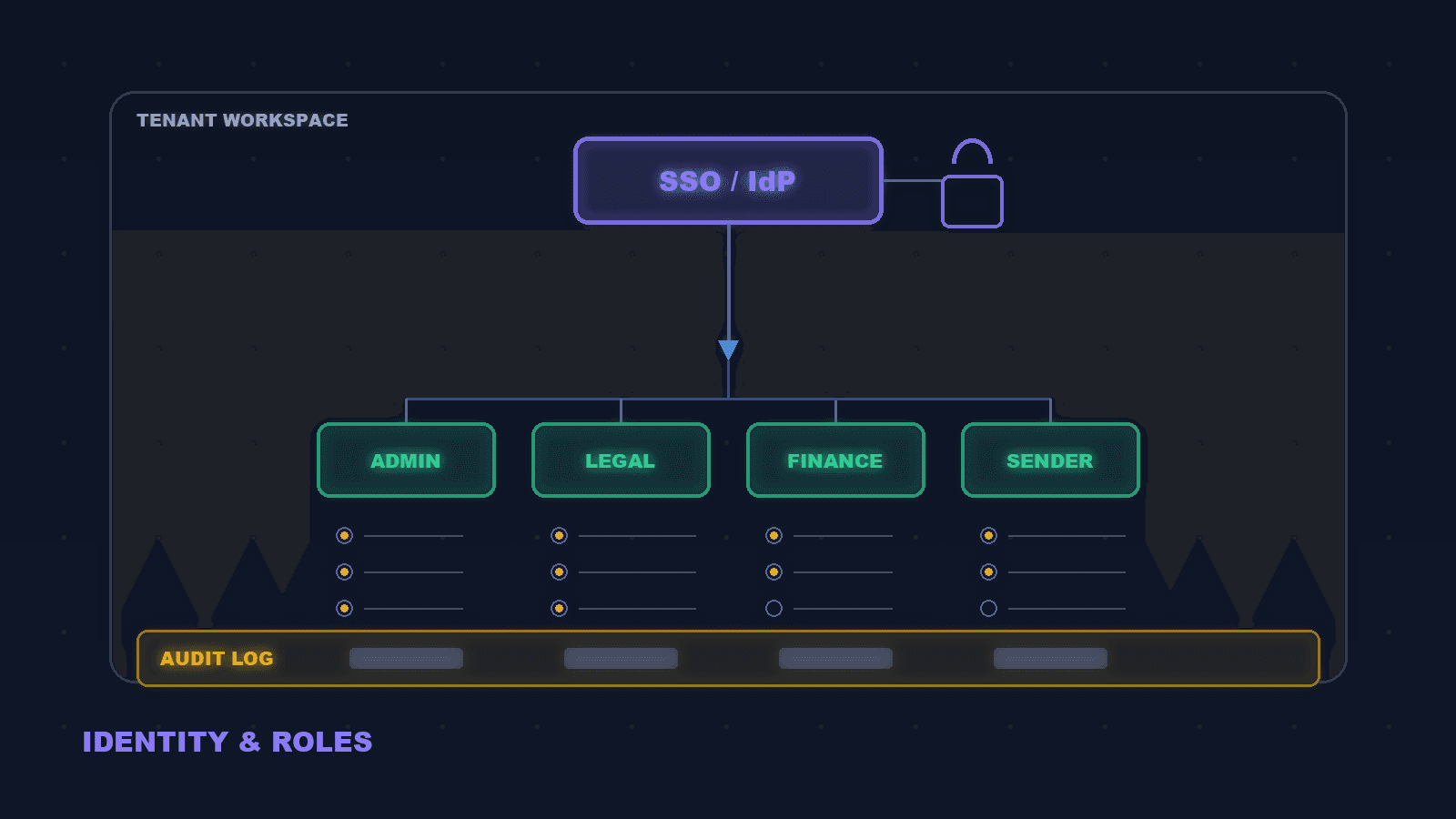
Identity governance is the layer buyers test last and regret first
Most electronic signature evaluations spend their time on signing: how a document gets sent, how a signer is verified, how the certificate is issued. The questions that decide whether the platform survives its second year are quieter. Can it authenticate through the identity provider the company already runs? Can an administrator grant exactly the permissions a department needs and nothing more? When an employee leaves, what happens to the envelopes and templates still in their name? These are not signing questions. They are identity governance questions, and they are the ones that surface in a security review three weeks after the business has already chosen a vendor. This guide sets out six governance capabilities and a fourteen-item scoring sheet you can take into that review.
Six capabilities that separate a departmental tool from a governed tenant
Score each item as present, partial, or absent. Four or more partial answers means the tenant will accumulate manual admin work within a year.
Single sign-on through a standards-based identity provider, with joining accounts requiring administrator approval rather than self-provisioning.
Roles that can be defined by the customer, not only the vendor's fixed administrator and member presets.
Permission points granular enough to let a team send and track documents without granting account-wide configuration rights.
A member lifecycle process: bulk invitation, a pending-invite list, and a single action that transfers a departing employee's assets.
Access controls on where a session can originate, such as an IP allowlist for sending activity.
Separated audit trails for member changes, API callbacks and seal operations, retained long enough to support an internal or regulatory review.
Existing identity content answers who the signer is, not who the administrator is
The site already covers signer identity at length: how to confirm the person on the other side of a signature is who they claim to be, which verification methods suit which risk level, and how national digital identity schemes change that calculus. That work addresses the external party. It says nothing about the internal party, which is the tenant's own staff. A procurement team asking whether the platform can connect to Microsoft Entra ID, whether a custom role can be limited to template editing, or what happens to a departed employee's envelopes is asking an entirely different question, and it usually arrives as a security questionnaire rather than an RFP. The two topics do not compete for the same search intent, which is why this guide addresses the internal side exclusively.
Federated SSO
- Authentication is delegated to the customer's identity provider, for example Microsoft Entra ID.
- Password policy, multi-factor enforcement and session lifetime stay under the customer's control.
- Deprovisioning in the identity provider becomes the single place an account is disabled.
- This is the only form that removes a separate credential set from the tenant.
Adjacent arrangements
- OAuth-linked accounts: a Microsoft or Google identity is used to sign in, but the tenant still holds its own account record.
- Domain-claim migration: existing accounts are converted to enterprise sign-in after the fact.
- Per-tenant policy toggles: password composition, lockout thresholds and two-factor can be set, but authentication is still local.
- API-only federation: machine credentials are governed by the customer, human accounts are not.
Fourteen items that decide whether a tenant is governable or merely usable
Take this into the security review. A vendor that cannot answer any row is not necessarily disqualified, but the gap should be priced into the rollout plan as manual administration.
| What to verify | Why it matters in year two | |
|---|---|---|
| Identity provider | Federated sign-in through a standard protocol, not a custom integration | Adding and removing staff stays in one system instead of two |
| Join approval | New accounts require administrator approval | Prevents unmanaged accounts appearing when a team self-invites |
| Role model | Customer-defined roles, not only vendor presets | Departments differ in what they should touch; presets force over-granting |
| Permission granularity | Permission points finer than send-versus-admin | A regional coordinator needs sending rights without global configuration |
| Password policy | Tenant-level composition rules and lockout thresholds | Local accounts that escape corporate policy become the audit finding |
| Multi-factor | Enforced for administrators independently of normal users | Administrator compromise is the highest-impact single failure |
| Bulk invitation | List-based invites with a visible pending state | Onboarding fifty staff one by one is the usual reason governance gets skipped |
| Invitation tracking | Pending invitations are listed and can be resent or revoked | Unaccepted invites are a recurring source of duplicate accounts |
| Offboarding transfer | A departed employee's envelopes, templates and seals move in one action | Orphaned assets are the most common post-audit remediation item |
| Workspace switching | Users move between workspaces or data centres without a second account | Multi-entity groups otherwise maintain parallel account sets |
| Origination control | IP allowlisting for document-sending activity | Restricts sending to corporate networks or approved egress points |
| Member audit log | Role changes, invitations and removals are recorded | Answers the who-granted-this question during an incident |
| API audit log | Callback and machine-credential activity is logged separately | Integration failures surface as security events otherwise |
| Seal audit log | Seal creation, use and handover are recorded distinctly | Seal misuse is a legal exposure, not an IT one |
A role model that never changed is a sign nobody audited the tenant
Most platforms start with two roles and add more only when customers push back. Read the role model as a history of customer pressure, not as a feature list.
The common starting point is a super-administrator who can do everything and a member who can send. That model survives until a procurement, legal or finance team asks to send documents without seeing billing or account settings. At that moment the tenant either grants full administrator rights to a department that should not have them, or it keeps sending through a shared administrator account. Both outcomes fail a security review.
A customer-defined role model fixes this by separating two concepts that the preset model conflates: what a role can touch, and which workspace scope it applies to. A legal operations role might create and edit templates, send envelopes from approved templates, and read all audit records for its own workspace, while being unable to modify billing, invite members, or change seal assignments. If the platform cannot express that sentence, the only way to approximate it is by spreading work across shared accounts.
The practical test is to write down three real job functions from your own organisation and ask the vendor to configure each one live. If the exercise requires creating a new shared account with a generic name, the role model is not granular enough. Pay particular attention to whether permissions can be scoped to a business unit, because a single global role set forces every regional team into the same permission envelope.
A related signal is the presence of a default role for developers. A tenant that supports API integration needs a role that can manage credentials and callbacks without inheriting document-sending rights, since integration accounts are frequently the ones that leak.
Offboarding is where identity governance stops being theory
Ask what happens to a departed employee's assets before you ask about pricing. The answer reveals whether the platform was designed for a team of ten or a company of ten thousand.
When someone leaves, three classes of asset remain in their name: envelopes still awaiting signature, templates they created or owned, and seals or certificates assigned to them. Each fails differently. An envelope awaiting signature under a disabled account stalls, and the counter-party sees no response. A template owned by a departed employee may become invisible to the team that needs it, or remain editable by whoever inherits the account. A seal assigned to a person creates a direct legal exposure if the account is reused.
The governance capability to look for is a single administrative action that reassigns all three classes at once, and a record showing that it happened. Vendors that support template ownership transfer and bulk reassignment on employee departure handle this cleanly. Vendors that require the administrator to touch each asset individually produce a process that is skipped when the departure is sudden.
Pair that with a bulk invitation process and a visible pending-invite list. The reason governance decays is rarely malice; it is friction. If onboarding fifty staff requires fifty individual invitations, teams create one shared account and route work through it, and every subsequent audit finding traces back to that shortcut. Invitations that can be issued as a list, tracked while pending, and resent on demand keep the tenant aligned with the corporate directory.
A last item worth verifying is whether a member's activity is separable from the account they used. Shared accounts destroy attribution, and a platform that logs actions per account rather than per person will not be able to answer an internal investigation.
Three logs, not one: member, API and seal activity fail in different ways
A single undifferentiated activity feed looks thorough and answers nothing. Ask for the logs to be separated by the kind of actor involved.
Member activity answers who changed a role, invited a colleague or removed access. Its consumer is the security team during a personnel or access incident. Machine activity covers callbacks, credential use and integration failures; its consumer is the engineering team debugging an integration, and a failure there is invisible in a member-oriented feed. Seal activity covers creation, assignment, use and handover of seals; its consumer is legal and compliance, and a misuse event is a legal exposure rather than an IT incident.
A tenant that offers only a unified feed forces three different teams to filter one stream for their own signals, which in practice means nobody does it. Ask the vendor to show each log separately, with retention periods stated. A member log kept for ninety days will not support an annual audit; a seal log that cannot be exported will not satisfy a regulator.
Retention is the second half of this question and it is usually answered vaguely. Establish the current retention window in writing, whether it is configurable, and whether export to a customer-controlled archive is available. For regulated industries the answer often needs to extend beyond the platform's own default, in which case the export path becomes the compliance control.
How to run the governance evaluation without a two-month detour
Four steps, in this order. Each produces an artefact the security reviewer will ask for anyway.
Write three real job functions
Pick a legal operations coordinator, a regional sales sender and a finance approver from your own organisation. Write the exact sentence describing what each must and must not touch. This becomes the configuration test, not a wish list.
Configure the three roles live
Ask the vendor to build them during the evaluation rather than describing them. Any step that requires a shared account or a workaround is a permanent cost, and it belongs in the rollout plan.
Run an offboarding drill
Create a test employee holding an envelope, a template and a seal. Disable the account, then ask the vendor to transfer all three. Time the operation and note what the audit record shows afterwards.
Request the three logs separately
Ask for a member log extract, an API callback log extract and a seal log extract covering the same week. If they arrive as one file, that is the answer to the question.
Frequently asked questions
Only federated SSO does. When authentication is delegated to the customer's identity provider, the tenant no longer maintains a credential set for those users and deprovisioning happens in one place. OAuth-linked accounts and per-tenant password policies leave a local account in place, which means two systems must be deprovisioned on the same day and one of them will eventually be missed.
