


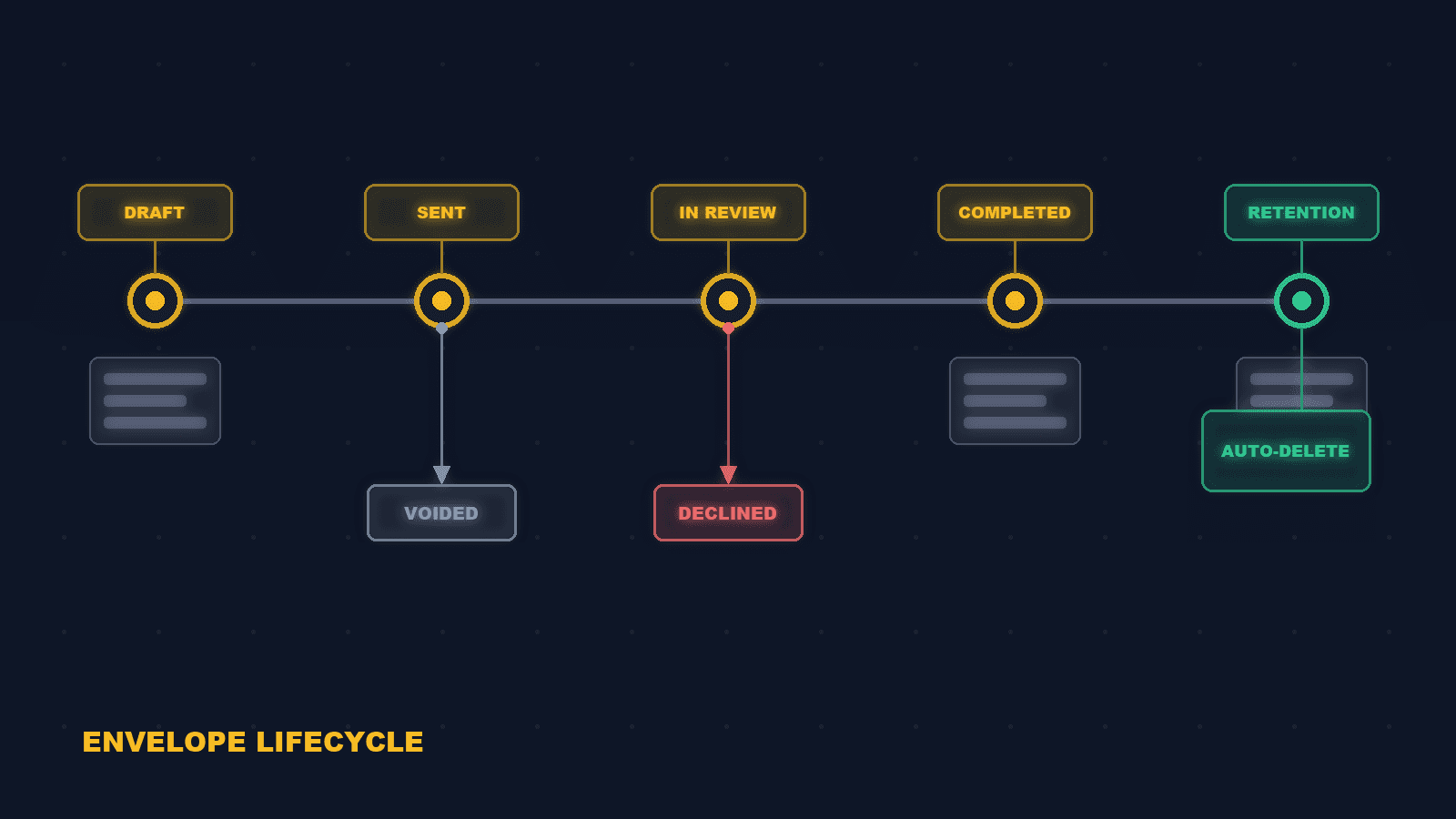
Envelope lifecycle is where two compliance requirements point in opposite directions
An envelope is not finished when the last signature lands. It moves through drafting, sending, waiting, completion or failure, and then a retention period that ends in either deletion or archival. That final stage is where electronic signature procurement quietly breaks down, because two legitimate requirements meet there and contradict each other. Records-retention rules in regulated industries can require an agreement to remain retrievable for years, while a data-minimisation policy requires that personal data be deleted once it is no longer needed. A platform that only offers a deletion schedule, or only offers indefinite storage, forces the buyer to violate one of the two. This guide covers the full lifecycle, treats bulk operations as a feature of that lifecycle rather than a separate topic, and identifies the decisions that must be made before rollout.
Six lifecycle controls, and the one that most often gets postponed
The sixth item is the one that turns a deployment into an audit finding if it is left undecided.
Drafts that can be prepared, reviewed and scheduled rather than sent the moment they are created.
An explicit expiry with a documented extension path, so an unanswered envelope resolves instead of sitting open indefinitely.
Withdrawal that preserves the original configuration, so a corrected document can be resent without rebuilding it.
Bulk operations across the whole lifecycle: send, remind, cancel and sign, applied to a list rather than one envelope at a time.
Retrieval by identifier and export of a filtered list, so an operational or audit request does not become a manual search.
A retention rule that distinguishes completed agreements from abandoned drafts, with an archive export path before deletion.
What retention rules demand
- Regulated agreements remain retrievable for a defined period, which in several jurisdictions runs to five years or longer.
- The evidence accompanying a signed document must survive as long as the document, including the audit trail and the identity verification record.
- Deletion must be demonstrably controlled, not accidental, and the process must be documented for the auditor.
- Retention periods differ by document class, so a single global setting rarely satisfies the requirement.
What data-minimisation demands
- Personal data is deleted when the purpose for processing it has ended.
- Abandoned drafts holding identity documents have no continuing justification and are the highest-risk category.
- Storage limitation applies to verification artefacts as much as to the signed document itself.
- An automatic deletion schedule is the usual mechanism offered, and it does not distinguish document classes by default.
Five states, two exception exits, and one terminal decision
Ask the vendor to demonstrate each transition with a real envelope. The exception exits matter more than the happy path, because that is where support tickets originate.
| What happens | What to verify | |
|---|---|---|
| Draft | Envelope exists but is not yet dispatched; editable and schedulable | Whether scheduling is supported, and who can edit a scheduled draft |
| Sent | Dispatched to recipients; waiting for action | Whether recipients can be added after sending, and by whom |
| In review | Partially signed; some recipients acted, others have not | Whether a partially signed document is readable, and by which roles |
| Completed | All required signatures collected; evidence sealed | Whether the completed file and audit trail are immediately downloadable |
| Retention | Retained for a period, then deleted or archived | Whether completed and abandoned records can follow different rules |
| Declined | A recipient refused, with a stated reason | Whether the reason is exported as structured data or only as free text |
| Voided | The sender withdrew the envelope before completion | Whether the original configuration is preserved for a resend |
Bulk is a lifecycle capability, not a volume feature
The reason to care about bulk operations is not throughput. It is that a lifecycle cannot be managed at all when every intervention is manual.
Teams evaluate bulk sends as a convenience for high-volume workflows, which undersells the capability. The operationally important bulk actions are the corrective ones: bulk remind for a cohort that has stalled, bulk cancel for a batch sent against a superseded document version, and bulk sign for a set of documents that share a single signer. Without these, the only way to correct a batch is to open each envelope individually, and the correction is deferred until it becomes someone's emergency.
This is why bulk functionality belongs in the lifecycle discussion rather than in a throughput discussion. A tenant sending two hundred envelopes a month still benefits from bulk cancel if it ever sends the wrong version, and that scenario arrives without warning. Establish which lifecycle transitions can be applied to a list, and whether the list can be built by filtering on state rather than by supplying identifiers manually.
The practical limit to test is how a batch behaves when part of it fails. A bulk operation applied to fifty envelopes where three are already completed should report per-item outcomes rather than aborting. Ask for the result view, not the success message, and check whether the failures are individually retryable.
Pair this with retrieval by identifier. When a customer or regulator supplies an envelope reference, the ability to locate it directly determines whether an inquiry takes one minute or one afternoon. Filtered list export extends the same capability to questions posed as ranges rather than as single references, which is how audit requests usually arrive.
An envelope with no expiry is an open liability with no owner
Expiry is the least discussed lifecycle control and the one that most reduces operational noise.
A document sent for signature and never answered stays open unless something closes it. In practice it holds a partially collected signature set, occupies a seat or envelope allowance, and sits in reporting as if it were active. Over months these accumulate until completion-rate reporting becomes meaningless, because the denominator is inflated by envelopes nobody intends to close.
An explicit expiry converts that ambiguity into a decision. The envelope resolves at a known time, the sender learns that it did, and the record shows why. The governance question is whether expiry can be extended manually and by whom, since a legitimate delay, such as a signer travelling, should not force the document to be rebuilt. Establish both halves: that expiry exists, and that it can be extended with an audit record.
There is a legal dimension as well. A signature block typically references a date, and an envelope that remains open for months can be signed long after the business event it was meant to document. An expiry aligned to the commercial window is therefore not only an administrative convenience; it keeps the evidence consistent with the transaction.
Withdrawal that discards the configuration turns a correction into a rebuild
Most platforms let you cancel an envelope. Far fewer let you cancel it and resend the corrected version without starting over.
The common scenario is a document containing an error that is discovered after dispatch. The sender cancels the envelope, then discovers that cancellation discarded the field placement, the recipient list and the routing order, and rebuilds the whole thing from the template. At low volume this is irritating; in a high-volume workflow it consumes the operational capacity that the platform was purchased to release.
The capability to look for is withdrawal that preserves the original configuration, so a corrected file can be substituted and redispatched with field positions and recipients intact. Confirm that the withdrawn envelope remains visible as withdrawn rather than disappearing, because an audit trail that omits the failed attempt is incomplete. Confirm also that the resent envelope carries its own reference, so the two attempts can be distinguished later.
A related case is the recipient-driven exception. When a signer declines, the stated reason is frequently captured as free text inside the audit trail and nowhere else, which makes it impossible to report on decline causes across a batch. Establish whether decline and withdrawal reasons are recorded as structured fields that can be exported, because that data is the input to fixing the process rather than fixing the individual document.
Four decisions to make before the first production send
Each of these can be made after rollout, at roughly ten times the cost and with a retroactive problem to explain.
Set retention by document class
List your document types and the retention period each requires. Confirm the platform can apply different periods rather than one global schedule, and that completed records are handled differently from abandoned ones.
Define the archive path before the first deletion
Decide where records go when the platform's retention period ends. An export path established before deletion runs is a control; the same path established afterwards is a recovery.
Write the expiry policy
Choose a default expiry window per document class, name who may extend it, and confirm extensions appear in the audit trail. Without a default, envelopes accumulate open.
Test one corrective bulk operation
Send a small batch, then apply a bulk remind and a bulk cancel to it. Review the per-item outcome report and confirm individual retry. This is the operation you will need under pressure.
Frequently asked questions
This is the single most important retention question, and the answer is not always yes. Completed agreements are governed by records-retention rules, while abandoned drafts holding identity documents are governed by data minimisation. A platform with one global deletion schedule forces the same period on both, which means either drafts are kept too long or agreements are deleted too early.
