
'%3e%3cpath%20fill-rule='evenodd'%20clip-rule='evenodd'%20d='M6.99935%2012.8327C10.221%2012.8327%2012.8327%2010.221%2012.8327%206.99935C12.8327%203.77769%2010.221%201.16602%206.99935%201.16602C3.77769%201.16602%201.16602%203.77769%201.16602%206.99935C1.16602%2010.221%203.77769%2012.8327%206.99935%2012.8327Z'%20stroke='%23666666'%20stroke-linecap='round'%20stroke-linejoin='round'/%3e%3cpath%20d='M1.16602%207H12.8327'%20stroke='%23666666'%20stroke-linecap='round'%20stroke-linejoin='round'/%3e%3cpath%20fill-rule='evenodd'%20clip-rule='evenodd'%20d='M6.99935%2012.8327C8.28802%2012.8327%209.33268%2010.221%209.33268%206.99935C9.33268%203.77769%208.28802%201.16602%206.99935%201.16602C5.71068%201.16602%204.66602%203.77769%204.66602%206.99935C4.66602%2010.221%205.71068%2012.8327%206.99935%2012.8327Z'%20stroke='%23666666'%20stroke-linecap='round'%20stroke-linejoin='round'/%3e%3cpath%20d='M2.875%202.95898C3.93063%204.01461%205.38896%204.66754%206.99978%204.66754C8.61062%204.66754%2010.069%204.01461%2011.1246%202.95898'%20stroke='%23666666'%20stroke-linecap='round'%20stroke-linejoin='round'/%3e%3cpath%20d='M11.1246%2011.0425C10.069%209.98691%208.61062%209.33398%206.99978%209.33398C5.38896%209.33398%203.93063%209.98691%202.875%2011.0425'%20stroke='%23666666'%20stroke-linecap='round'%20stroke-linejoin='round'/%3e%3c/g%3e%3cdefs%3e%3cclipPath%20id='clip0_1267_9109'%3e%3crect%20width='14'%20height='14'%20fill='white'/%3e%3c/clipPath%3e%3c/defs%3e%3c/svg%3e)


eCoC Compliance Implementation Plan for Chinese OEMs: An Eight-Phase Roadmap to the July 5, 2026 Effective Date
'%3e%3cpath%20d='M20.3088%200H3.6912C1.6596%200%200%201.6488%200%203.666V20.334C0%2022.3512%201.6596%2024%203.6912%2024H20.3088C22.3368%2024%2024%2022.3512%2024%2020.334V3.666C24%201.6488%2022.3368%200%2020.3088%200ZM21.0372%2019.8792C19.344%2019.8792%2017.6556%2019.8792%2015.9612%2019.884C15.8436%2019.884%2015.78%2019.8336%2015.7116%2019.7496C14.3868%2018.0216%2013.0584%2016.2972%2011.7288%2014.5728C11.6916%2014.5224%2011.6484%2014.472%2011.5932%2014.4012L11.4456%2014.5608C9.9216%2016.2888%208.3976%2018.0216%206.8736%2019.7532C6.83925%2019.797%206.79476%2019.8318%206.74395%2019.8546C6.69315%2019.8774%206.63757%2019.8875%206.582%2019.884C5.766%2019.8792%204.9524%2019.8792%204.08%2019.8792C6.1884%2017.4876%208.262%2015.132%2010.3404%2012.7692C8.1444%209.9192%205.9556%207.0716%203.75%204.2084C3.81%204.2%203.8472%204.188%203.8856%204.188C5.634%204.188%207.3776%204.188%209.126%204.1832C9.2616%204.1832%209.3168%204.2552%209.384%204.3428C10.56%205.8908%2011.7372%207.434%2012.9144%208.9808C12.9648%209.048%2013.0164%209.1152%2013.0836%209.1992C13.1304%209.1488%2013.1772%209.1032%2013.2192%209.0564L17.3832%204.326C17.4173%204.28115%2017.4617%204.24519%2017.5127%204.22116C17.5637%204.19714%2017.6197%204.18576%2017.676%204.188C18.4428%204.1916%2019.212%204.1916%2019.9788%204.1916H20.1864L14.3328%2010.8396L21.2064%2019.8672C21.126%2019.8708%2021.084%2019.8792%2021.0372%2019.8792Z'%20fill='black'/%3e%3c/g%3e%3cdefs%3e%3cclipPath%20id='clip0_2781_2582'%3e%3crect%20width='24'%20height='24'%20fill='white'/%3e%3c/clipPath%3e%3c/defs%3e%3c/svg%3e)

'%3e%3cpath%20d='M21.336%200H2.664C1.95811%200.00210824%201.28174%200.283456%200.782596%200.782596C0.283456%201.28174%200.00210824%201.95811%200%202.664L0%2021.336C0.00210824%2022.0419%200.283456%2022.7183%200.782596%2023.2174C1.28174%2023.7165%201.95811%2023.9979%202.664%2024H21.336C22.0419%2023.9979%2022.7183%2023.7165%2023.2174%2023.2174C23.7165%2022.7183%2023.9979%2022.0419%2024%2021.336V2.664C23.9979%201.95811%2023.7165%201.28174%2023.2174%200.782596C22.7183%200.283456%2022.0419%200.00210824%2021.336%200ZM8.256%2018.664H4.85599V8.80003H8.256V18.664ZM6.56801%207.464C6.08545%207.48573%205.61398%207.31516%205.25703%206.9897C4.90008%206.66425%204.6868%206.21049%204.66399%205.72798C4.68886%205.2469%204.90303%204.79519%205.25975%204.47145C5.61647%204.14771%206.08678%203.97823%206.56801%204.00001C7.04924%203.97824%207.51954%204.14773%207.87626%204.47147C8.23298%204.79521%208.44714%205.24693%208.472%205.72801C8.4451%206.20767%208.23005%206.65734%207.87356%206.97938C7.51707%207.30142%207.04792%207.46981%206.56801%207.44799V7.464ZM20.216%2018.664H16.8V13.328C16.8%2012.232%2016.368%2011.136%2015.088%2011.136C14.8139%2011.1463%2014.5449%2011.2132%2014.2979%2011.3323C14.0508%2011.4515%2013.831%2011.6203%2013.6523%2011.8284C13.4736%2012.0364%2013.3397%2012.2791%2013.2591%2012.5413C13.1785%2012.8035%2013.153%2013.0795%2013.184%2013.352V18.656H9.888V8.80001H13.208V10.224C13.551%209.69217%2014.0263%209.2585%2014.5872%208.96542C15.1481%208.67234%2015.7755%208.52988%2016.408%208.55199C17.824%208.55199%2020.24%209.264%2020.24%2013.12L20.216%2018.664Z'%20fill='black'/%3e%3c/g%3e%3cdefs%3e%3cclipPath%20id='clip0_2754_1960'%3e%3crect%20width='24'%20height='24'%20fill='white'/%3e%3c/clipPath%3e%3c/defs%3e%3c/svg%3e)
According to the requirements of EU Regulation (EU) 2018/858 and its implementing regulation Commission Implementing Regulation (EU) 2024/1061, starting from July 5, 2026onwards, all newly manufactured M, N, and O category vehicles must use an electronic Certificate of Conformity (eCoC) and submit it via XML + digital electronic seal (eSeal).
This is less than eight weeks before the effective date. This document is targeted at the decision-makers of Chinese OEMs exporting to the EU, outlining the core challenges of eCoC compliance, the eight-phase implementation plan provided by esign.ai, the division of responsibilities among stakeholders, and an actionable project schedule within the remaining timeframe.
I. Three Core Challenges of eCoC Compliance
Manufacturers must complete three core preparations:
- Obtain a corporate electronic seal (eSeal) compliant with eIDAS requirements
- Establish capabilities for generating and signing eCoC XML
- Complete data exchange with Member State NAP systems and EUCARIS
None of these can be resolved simply by "procuring a signature service"; the respective difficulties are as follows:
First, the legal level of the electronic seal and restrictions on issuing authorities. The regulation permits two types of electronic seals—Advanced Electronic Seal (AdESeal) and Qualified Electronic Seal (QESeal). AdESeal represents the minimum legal requirement for eCoC submission and may be issued by a Qualified Trust Service Provider (QTSP) on the EU Trusted List, or by a non-qualified certificate issuing authority (see Article 36 of Regulation 910/2014). esign.ai has opted for issuance by an EU Trusted List QTSP, ensuring trust compatibility across the entire EU while reserving a pathway for future upgrades to QESeal.
Key fact: CA institutions within China (CFCA, Shanghai CA, Guangdong CA, including eSignbao's own domestic CA) are not listed on the EU Trusted List. Chinese OEMs must apply for the eSeal through an EU QTSP, a process that includes submitting business licenses, powers of attorney, conducting KYC video calls with authorized personnel, and activating PIN codes.
Second, the challenge of eCoC XML lies not in generation, but in data governance. The eCoC XML adheres to the IVI 2.0 standard (Initial Vehicle Information 2.0), encompassing hundreds of vehicle technical parameter fields. For most Chinese OEMs, source data is fragmented across ERP, PLM, quality inspection systems, and R&D laboratory documentation, and has historically not been managed under standards requiring it to be "machine-readable, suitable for cross-border transfer, and directly consumable by EU member state registration systems." Field mapping and business rule configuration constitute the actual bottleneck during the XML preparation phase.
Third, passing XSD validation does not guarantee acceptance. At present, only the Dutch RDW actually receives EU eCoCs (connections between other member states' NAPs and EUCARIS will be progressively established over the next few months). The RDW acceptance environment conducts business rule checks that go beyond the schema—such as VIN internal consistency, type approval number format, and fuel type combinations for hybrid models. RDW also requires automakers to submit sample eCoCs separately for each supported vehicle category (M1, N2, L1e, etc.) and each variant (fully electric, plug-in hybrid, non-electric, etc.). Authorization to access the production environment is only granted after successful evaluation.
II. esign.ai Eight-Phase Implementation Plan
esign.ai (the overseas brand of eSignBa, Hangzhou Tiangu Information Technology) divides the complete eCoC compliance project into eight phases, with a standard cycle of 12 to 16 weeks.
Overall Implementation Phase
| Phase | Recommended Timeline | Core Tasks |
|---|---|---|
| Phase 1 | Start Immediately | Project Initiation and Vendor Selection |
| Phase 2 | 1–2 Weeks | Commercial Negotiation and Contract Execution |
| Phase 3 | 1–2 weeks | eSeal certificate application |
| Phase 4 | 1–2 weeks | XML file preparation and specification validation |
| Phase 5 | 2–3 weeks | API system integration and testing |
| Phase 6 | 2 weeks | Compliance verification and signature confirmation |
| Phase 7 | 1–2 weeks | NAP / EUCARIS integration |
| Phase 8 | Before July 5, 2026 | Official Go-Live |
Phase 1: Project Initiation and Supplier Selection
Automaker Action Items
- Designate project lead (IT / Legal / QA / Procurement)
- Confirm applicable vehicle model scope (Class M / N / O)
- Estimate expected signing volume
- Draft and issue RFP / bidding documents
Support provided by esign.ai
- Technical Specification Document
- Product Solution Overview
- Regulatory Interpretation Materials
- Interface Documentation Sample
Phase 2: Commercial Negotiation and Contract Signing
Automaker Action Items: Complete technical evaluation, business negotiations, determine procurement quantity, and sign the master contract and service agreement.
Phase III: Enterprise Electronic Seal (eSeal) Application
Objective: Apply for an Advanced Electronic Seal (AdESeal) or Qualified Electronic Seal (QESeal) from a QTSP on the EU Trusted List.
Channel Configuration
- Single Channel: Apply to 1 CA, prepare 1 set of application materials
- Dual Channel: Apply to 2 CAs, prepare 2 sets of application materials, provide failover redundancy
Automotive manufacturers with high annual export volumes are recommended to default to dual channels.
Documents Required from Automotive Manufacturers
- Scanned copy of Business License (official seal recommended)
- Company English Name and Registered Address
- Authorization Letter (Power of Attorney)
- Authorized Representative's ID / Passport
- Authorized Representative's Email and Phone Number
Representative Arrangement
Option A: Self-handled by internal automaker staff —— The automaker designates an employee as the application contact to independently coordinate with the CA organization to complete the certification.
Option B: esign.ai agency service —— The automaker authorizes esign.ai staff as the application contact to provide full-process assistance. Specific workflow:
- QTSP sends an activation email to the esign.ai contact, containing a link to the TSP onboarding portal
- The esign.ai contact completes the following in the portal: fills out personal and company information online; uploads copies of personal ID documents and the completed application form (including proof of representation, with all files merged into a single PDF); accepts the TSP privacy policy; schedules a video call with TSP authorized personnel
- The contact joins the video call at the agreed time
- After the video call, the contact receives an email with the certificate activation link and creates a PIN code (stored in encrypted format in the TSP system)
- The contact returns the PIN code to esign.ai via a secure channel, authorizing its use according to the automaker's API invocation commands
Estimated Time:1–2 weeks (processing times vary by CA). The Chinese Lunar New Year and European summer holidays are known bottleneck periods.
Phase 4: eCoC XML Preparation and Validation
Items to be Completed by the Automaker
- Generate XML based on the IVI 2.0 standard
- Fill in vehicle technical specifications
- Complete Schema Validation
Reference Standards
- Commission Implementing Regulation (EU) 2021/133
- IVI 2.0 Schema
- XMLDSig / XAdES
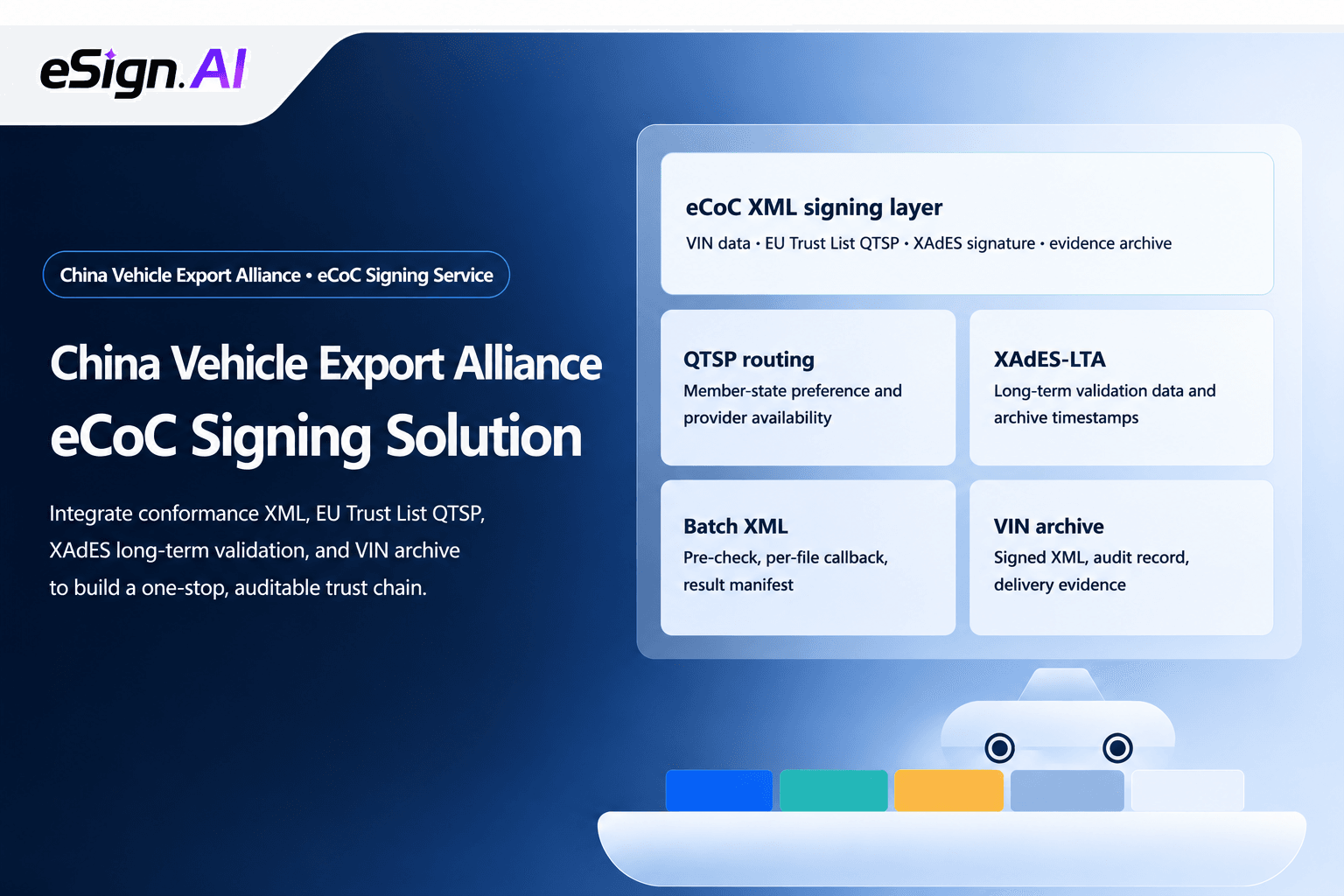
Supported by esign.ai:Pre-built XML templates based on vehicle categories (M1, N2, L1e, etc.) and powertrain types (pure electric, plug-in hybrid, fuel), ERP / PLM / quality inspection system field mapping tools, and three-layer validation (XML syntax + CoC / IVI Schema + business fields).
Important Notice:Phase 3 (eSeal application) and Phase 4 (XML preparation) muststart in parallel,which is the most critical decision for compressing the overall project schedule.
Phase 5: API System Integration and Testing
esign.ai provides interfaces
- Create Signing Task
- Batch Signing Tasks
- Query Task Status
- Download Signed Documents
- XML Validation
- Signature Verification Interface
Core Technical Parameters
| Parameters | Specifications |
|---|---|
| Signature Standard | XAdES (ETSI EN 319 132-1 / 132-2), supports XAdES-T / LT / LTA |
| Signature Algorithm | RSA-SHA256, 2048-bit key, compliant with ETSI EN 319 411 |
| Envelope Mode | Enveloped XAdES (Embedded XML) |
| Single Batch Limit | 100 records / API call |
| Concurrency Capacity | ≥100 TPS |
| System Availability | ≥99.9% |
| Private Key Management | HSM remote signing, FIPS 140-2 Level 3, private keys never stored locally |
| Verification compatibility | Passed official testing for EU DSS v5.11 and above |
| Disaster Recovery RTO / RPO | RTO ≤ 1 hour / RPO ≤ 5 minutes |
Automotive OEM development work: Integrate API, implement callback interfaces, handle errors, and set up automatic retries. esign.ai provides Java sample code for single/batch signing and verification, Postman collections, and API documentation.
Test content: Single-file signing, batch signing, exception handling, performance testing.
Regarding XAdES profiles: The regulatory minimum requirement is a basic electronic signature (a qualified code signing certificate + xmldsig is sufficient; XAdES is a best practice but not mandatory). esign.ai defaults to recommending XAdES-LTA in production. Since an eCoC may still be cited in product liability lawsuits ten years after vehicle sale, LTA embeds the certificate chain, CRL/OCSP validation data, and archival timestamps within the signature itself, ensuring a validation validity period of ≥10 years.
Phase 6: Compliance Verification and Signature Confirmation
Work content
- Perform complete verification on signed XML files
- Validate XAdES signature structure
- Verify certificate chain, timestamp, and OCSP/CRL
- Confirm acceptability with RDW or other competent authorities
Supported by esign.ai: Sample files, technical validation reports, and communication support with regulatory authorities.
RDW Acceptance Process: Prior to approving the transmission of eCoCs to the production environment, RDW requires automakers to first send eCoCs to the acceptance environment. Once RDW verifies that the eCoC quality meets standards, it authorizes the automaker to proceed with sending them to the production environment. Automakers must submit sample eCoCs individually for each supported vehicle category (e.g., M1, N2, L1e, etc.) and for each variant (fully electric, plug-in/non-plug-in hybrid, non-electric).
RDW Acceptance Environment Address:https://ecocproxy.gatrdw.nl/InitialVehicleInformation.svc(This is a web service address, not a website)
Phase 7: Integration with NAP and EUCARIS Systems
NAP(National Access Point): National Access Points in each member state for receiving eCoC data.
EUCARIS: European Vehicle Information Exchange System responsible for data synchronization between member states.
Current Status: Currently, only RDW receives related eCoCs; other member states have not yet integrated. Connectivity with EUCARIS will be established within the coming months.
Tasks for Automakers to Complete: Complete interface integration testing, obtain test and production environment parameters, and perform upload testing.
Output results: XML upload successful, VIN queryable by EU member states, data synchronized to EUCARIS.
Manual upload backup channel(Transition period contingency plan):https://ecoc.eucaris.net/generate
Phase 8: Production Go-Live
Pre-Go-Live Checklist
- eSeal certificate valid
- Stable XML generation
- API testing completed
- NAP integration completed
- SLA monitoring configuration completed
- Disaster recovery plan ready
Official operation: Starting from July 5, 2026, all newly produced vehicles will be processed through the eCoC workflow.
III. Recommended Project Schedule (Backward Planning)
| Time | Recommended Tasks |
|---|---|
| May 2026 | Project initiation and vendor selection |
| End of May 2026 | Complete contract signing |
| Early June 2026 | Complete eSeal application |
| Mid-June 2026 | Complete XML preparation |
| Mid-to-late June 2026 | API integration and testing |
| End of June 2026 | Complete NAP / EUCARIS integration testing |
| Early July 2026 | Go-live Preparation |
| July 5, 2026 | Regulations officially take effect |
IV. Division of Responsibilities
| Work Content | Automaker | esign.ai | QTSP / CA | Competent Authority |
|---|---|---|---|---|
| Project Management | ✓ | Assist | ||
| Bidding and Procurement | ✓ | Assist | ||
| Contract Signing | ✓ | ✓ | ||
| eSeal Application Documents | ✓ | Assist | ✓ | |
| Certificate Issuance | ✓ | |||
| API Development | ✓ | ✓ | ||
| XML Generation | ✓ | Assistance | ||
| Compliance Verification | ✓ | ✓ | ||
| NAP Integration | ✓ | Assistance | ✓ | |
| Official Operation | ✓ | ✓ | ✓ |
V. Complete Support Provided by esign.ai
- Regulatory Consulting: Practical interpretation of eIDAS, Regulation (EU) 2018/858, (EU) 2021/133, and (EU) 2024/1061
- Technical Specifications: Complete product parameters and integration guidelines
- eSeal Application Assistance: Includes agency service for Option B, integration with multiple QTSPs on the EU Trusted List
- XAdES Signature API:XAdES-T / LT / LTA Level 3, compliant with ETSI EN 319 132 / 319 411
- Batch Signing Service:100 items per batch, distributed asynchronous concurrency, outputs signed files + result list + failure report
- Compliance Verification:Independent post-signing XML verification, pre-screening before submission to RDW
- RDW Communication Support:Sample submission, acceptance feedback, communication with TAA agencies
- NAP Access Support:Currently RDW, future synchronous access to NAPs of other member states
- 24/7 Operational Support:≥99.9% system availability, HSM Level 3 private key custody, adaptation within 45 days of regulatory updates
- Vehicle Registration Verification Assistance:EU vehicle registration verification support for ≥10 test vehicles
VI. Risk Assurance
| Risk Type | Response Measures |
|---|---|
| Regulatory Changes | Complete technical upgrade within 45 days |
| CA Failure | Multi-QTSP redundancy, automatic failover to backup CA |
| System Failure | Multi-Availability Zone deployment, RTO ≤ 1 hour |
| Certificate Revocation | Provide backup certificate within 4 hours |
7. If we do not start now, it will be too late by July 5.
Less than eight weeks remain until July 5. The earliest start date for the eight-phase schedule is this week; there is no more flexible version available.
Assuming a launch today (mid-May 2026), a 12-week schedule allows readiness by early August. Given that the EU eCoC is currently only accepted via RDW, and RDW itself conducts acceptance procedures, automakers targeting a "May launch, August go-live" still have a window to salvage the situation: vehicles can continue to be processed through original channels until RDW completes acceptance and authorizes the production environment.
If the launch is delayed by another month, the QTSP processing cycle combined with the European summer holidays could push certificate issuance to late September; the actual project go-live would fall in October—meaning vehicles exported between July and October would need to be verified individually based on RDW's actual acceptance status at that time. This is an uncontrollable gamble.
If your company is currently delaying the project based on the assumption that "the EU deadline has been extended to November," please review esign.ai's accompanying analysis first:"Important Notice: EU eCoC Transition Arrangements Do Not Provide a Buffer for Chinese Automakers—The Deadline Remains July 5, 2026". The current MVWG transition arrangement is practically unfeasible for Chinese automakers; delaying the project based on this would simultaneously trigger multiple compliance risks.
esign.ai can arrange a compliance expert working session within one week. Based on your company's target country mix, expected signing volume, and current internal system status, we will provide a feasible eight-phase scheduling plan.
This article was compiled and published by the compliance team of esign.ai (the overseas brand of eSignBa) for reference only and does not constitute legal advice.


