'%3e%3cpath%20fill-rule='evenodd'%20clip-rule='evenodd'%20d='M6.99935%2012.8327C10.221%2012.8327%2012.8327%2010.221%2012.8327%206.99935C12.8327%203.77769%2010.221%201.16602%206.99935%201.16602C3.77769%201.16602%201.16602%203.77769%201.16602%206.99935C1.16602%2010.221%203.77769%2012.8327%206.99935%2012.8327Z'%20stroke='%23666666'%20stroke-linecap='round'%20stroke-linejoin='round'/%3e%3cpath%20d='M1.16602%207H12.8327'%20stroke='%23666666'%20stroke-linecap='round'%20stroke-linejoin='round'/%3e%3cpath%20fill-rule='evenodd'%20clip-rule='evenodd'%20d='M6.99935%2012.8327C8.28802%2012.8327%209.33268%2010.221%209.33268%206.99935C9.33268%203.77769%208.28802%201.16602%206.99935%201.16602C5.71068%201.16602%204.66602%203.77769%204.66602%206.99935C4.66602%2010.221%205.71068%2012.8327%206.99935%2012.8327Z'%20stroke='%23666666'%20stroke-linecap='round'%20stroke-linejoin='round'/%3e%3cpath%20d='M2.875%202.95898C3.93063%204.01461%205.38896%204.66754%206.99978%204.66754C8.61062%204.66754%2010.069%204.01461%2011.1246%202.95898'%20stroke='%23666666'%20stroke-linecap='round'%20stroke-linejoin='round'/%3e%3cpath%20d='M11.1246%2011.0425C10.069%209.98691%208.61062%209.33398%206.99978%209.33398C5.38896%209.33398%203.93063%209.98691%202.875%2011.0425'%20stroke='%23666666'%20stroke-linecap='round'%20stroke-linejoin='round'/%3e%3c/g%3e%3cdefs%3e%3cclipPath%20id='clip0_1267_9109'%3e%3crect%20width='14'%20height='14'%20fill='white'/%3e%3c/clipPath%3e%3c/defs%3e%3c/svg%3e)
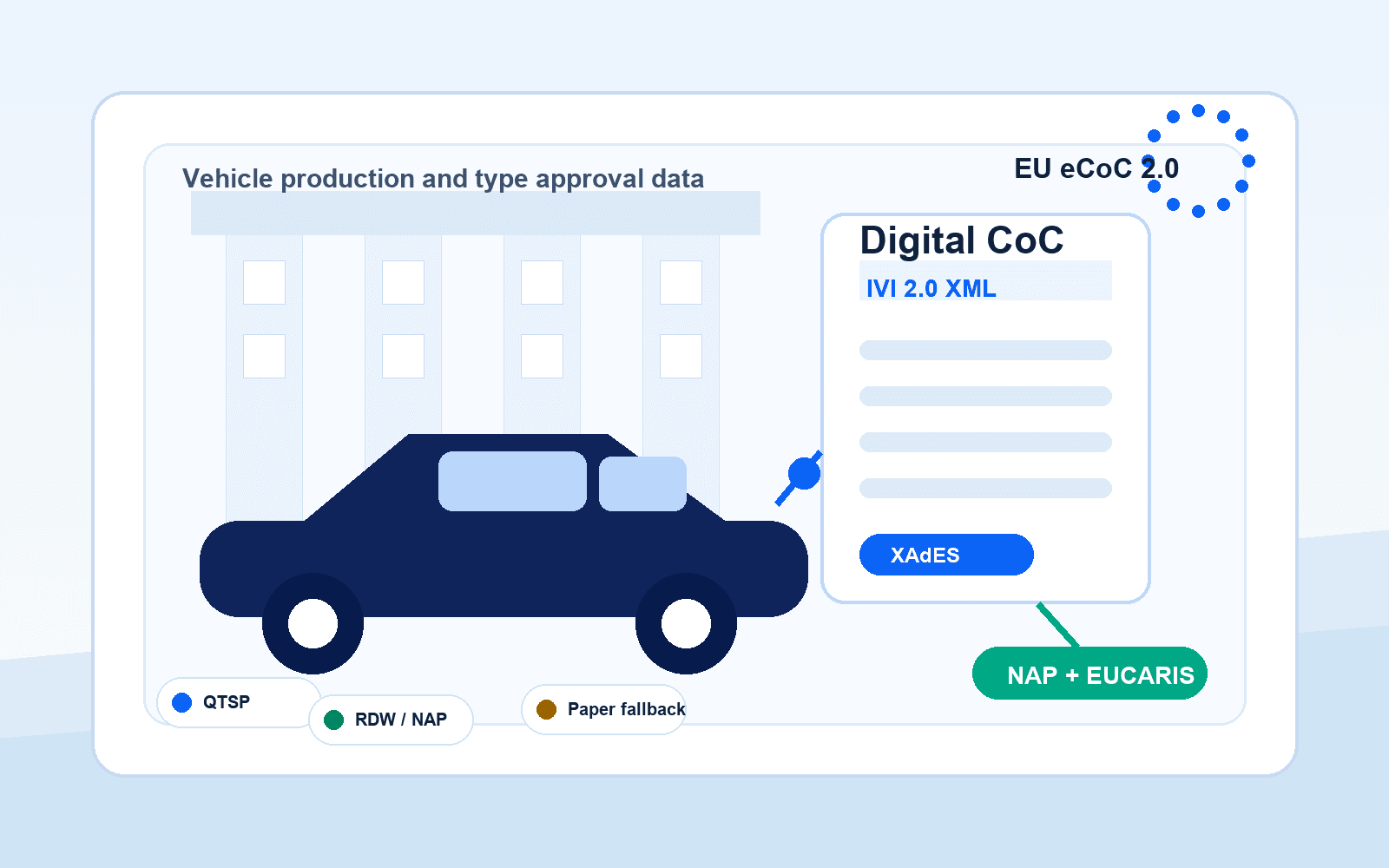
CoC digital dan kertas boleh berjalan serentak
Pasar yang siap seperti Belanda dan Jerman dapat menerima eCoC digital, sementara Perancis, Itali, Polandia, dan pasar lainnya mungkin masih memerlukan CoC kertas selama persiapan.



Diperbarui Mei 2026
Perbincangan eCoC terbaru bukan hanya tentang tanggal. Ia tentang kesiapan negara anggota yang berbeza, pemilihan titik akses, kebutuhan sertifikat, dan mempertahankan CoC kertas tersedia di tempat pasar tujuan masih mengandalkan ia.
Pasar yang siap seperti Belanda dan Jerman dapat menerima eCoC digital, sementara Perancis, Itali, Polandia, dan pasar lainnya mungkin masih memerlukan CoC kertas selama persiapan.
Pabrik tidak perlu mengajukan melalui negara asal atau negara penerimaan jenis. Sertifikat penerimaan jenis Jerman dapat menggunakan RDW NAP Belanda ketika titik akses itu adalah jalur operasional yang lebih baik.
Dasar peraturan
Keputusan Pembeli
Keputusan eCoC adalah operasional sama seperti hukumnya. Pencetak memerlukan laluan data, laluan sertifikat, laluan titik akses, dan laluan penggantian.
Model operasi merangkumi IVI XML berstruktur, data VIN, nama sah pengeluar, medan type approval dan semakan ICM. eCoC bukan pemindahan fail mudah—ia adalah pakej data XML yang memerlukan tandatangan, pengesahan dan bukti pengarkiban.
Seorang pengeluar yang menjual di seluruh Eropah mungkin memerlukan eCoC digital untuk pasaran yang siap dan CoC kertas untuk pasaran yang masih mempersiapkan proses pengambilan atau pendaftaran.
Sertifikat perlu datang dari QTSP di Senarai Kepercayaan EU, termasuk penandatanganan digital dan penggunaan kunci tak dapat dipungut, dan sepadan dengan nama pengeluar dalam persetujuan jenis.
Pintu masuk ke siap
Gunakan satu jalur baris kendaraan, target negara anggota, dan status sijil untuk memeriksa Laluan NAP, QTSP, dan laluan penggantian kertas sebelum perancangan produksi.
Definisi operasi
Operasi eCoC yang dapat dipercayai menghubungkan empat lapisan: data kendaraan, kepercayaan sijil, penghantaran NAP, dan pemeliharaan bukti. Pabrikan masih memerlukan arahan pasaran tujuan dan penggantian kertas di tempat pengambilan digital belum siap.
Sediakan IVI 2.0 XML, data peringkat VIN, medan type approval, semakan skema dan pengesahan ICM. Sistem penerima perlu menyokong ujian data produksi.
Gunakan sijil QTSP Trust List EU dengan penggunaan kunci yang diperlukan dan sepadan dengan nama pabrikan.
Pilih NAP seperti RDW apabila ia memberikan kesiapan, akses endpoint dan proses ujian yang lebih baik. Sahkan pertukaran kunci awam dan laluan penyerahan produksi XAdES.
Tangguhkan kertas CoC semasa transisi untuk negara-negara tujuan yang belum dapat mengambil atau menerima eCoC digital.
Keputusan laluan
Perbincangan dengan perekabentuk yang betul bermula selepas pengeluar telah memaparkan pemilihan NAP, pengesahan sijil, pemeriksaan kualiti data, dan pilihan kembalikan CoC kertas.
| Route | Typical use | What to confirm | eSign.AI role |
|---|---|---|---|
| Pemilihan NAP | Hantar eCoC melalui access point yang telah disediakan, walaupun negara type approval berbeza. | Endpoint, tetingkap ujian, pertukaran sijil awam, peraturan penyerahan produksi, dan kesediaan pengambilan destinasi. | Sediakan pakej XML bertandatangan, status batch, rekod callback, dan pemulangan arkib untuk aliran NAP yang dipilih. |
| Pengesahan sijil | Tandatangani eCoC dengan sijil yang diterima di bawah kerangka kepercayaan EU. | Status QTSP, rantai sijil, status pembatalan, kegunaan kunci, padanan nama pengeluar, dan polisi seal. | Halakan tandatangan XAdES atau XMLDSIG melalui laluan sijil yang terkawal dan simpan bukti pengesahan. |
| Semakan kualiti data | Sahkan IVI XML dan data kenderaan sebelum penyerahan untuk mengurangkan batch yang ditolak. | Pemetaan IVI 2.0 XML, data VIN, medan type approval, pengesahan sampel, dan semakan ICM. | Sahkan batch sebelum penyerahan dan pulangkan rekod kejayaan atau kegagalan setiap fail. |
| Cadangan CoC kertas | Menyokong pasaran yang masih memerlukan dokumen kertas semasa peralihan. | Kesediaan negara destinasi, arahan pasukan pendaftaran, polisi arkib, dan pengendalian pendua. | Kekalkan keselarasan bukti XML bertandatangan, rekod VIN, dan operasi pendua kertas. |
Pemilihan NAP
Hantar eCoC melalui access point yang telah disediakan, walaupun negara type approval berbeza.
Endpoint, tetingkap ujian, pertukaran sijil awam, peraturan penyerahan produksi, dan kesediaan pengambilan destinasi.
Sediakan pakej XML bertandatangan, status batch, rekod callback, dan pemulangan arkib untuk aliran NAP yang dipilih.
Pengesahan sijil
Tandatangani eCoC dengan sijil yang diterima di bawah kerangka kepercayaan EU.
Status QTSP, rantai sijil, status pembatalan, kegunaan kunci, padanan nama pengeluar, dan polisi seal.
Halakan tandatangan XAdES atau XMLDSIG melalui laluan sijil yang terkawal dan simpan bukti pengesahan.
Semakan kualiti data
Sahkan IVI XML dan data kenderaan sebelum penyerahan untuk mengurangkan batch yang ditolak.
Pemetaan IVI 2.0 XML, data VIN, medan type approval, pengesahan sampel, dan semakan ICM.
Sahkan batch sebelum penyerahan dan pulangkan rekod kejayaan atau kegagalan setiap fail.
Cadangan CoC kertas
Menyokong pasaran yang masih memerlukan dokumen kertas semasa peralihan.
Kesediaan negara destinasi, arahan pasukan pendaftaran, polisi arkib, dan pengendalian pendua.
Kekalkan keselarasan bukti XML bertandatangan, rekod VIN, dan operasi pendua kertas.
Aliran penghantaran
Pemantauan luar negara adalah mungkin, tetapi pemulihan kekal seperti isyarat masuk. Jika negara tujuan tiada titik pemulihan EUCARIS, aliran pendaftaran mungkin masih memerlukan CoC kertas.
Hantar permintaan kepada operator NAP, dapatkan titik akhir, dan pastikan laluan ujian.
Sediakan bahan sijil awam dan jajarkan sijil tandatangan serta pengangkutan mengikut keperluan NAP sasaran.
Jalankan semakan tandatangan, rantai kepercayaan sijil, semakan pembatalan dan pengesahan ICM. Sahkan peranan penandatangan dan format tandatangan dalam ujian.
Pulangkan rekod bertandatangan, hasil pengesahan, bukti sijil dan jejak callback status. Arkibkan bukti penyelesaian untuk setiap VIN.
Flow kerja eSign.AI
eSign.AI berada di antara sistem OEM, laluan sertifikat QTSP, dan persediaan penghantaran NAP. Tujuannya adalah operasi batch yang diperkirakan daripada penandatanganan XML sekali sahaja.
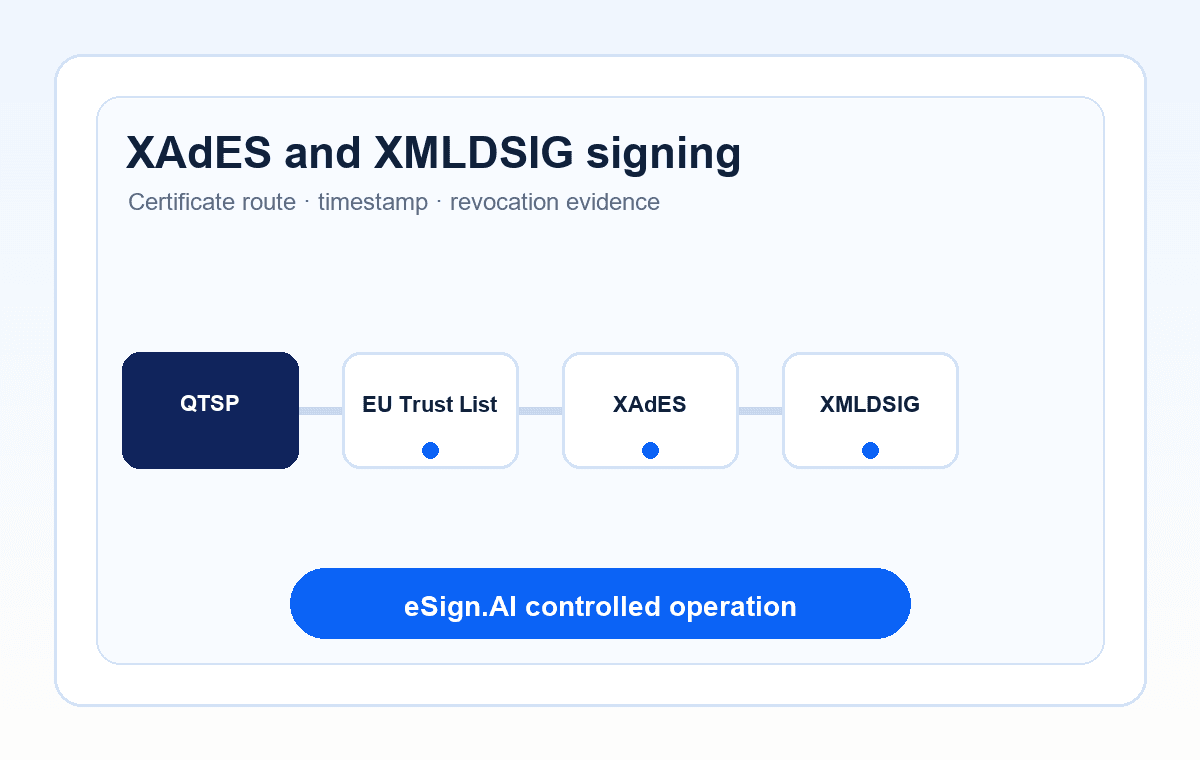
Dukung laluan penandatanganan XAdES yang disarankan dan XMLDSIG di mana diperlukan, dengan sertifikat, masa, penggubal, dan bukti pengesahan yang diselaraskan untuk setiap fail XML yang ditandatangani.
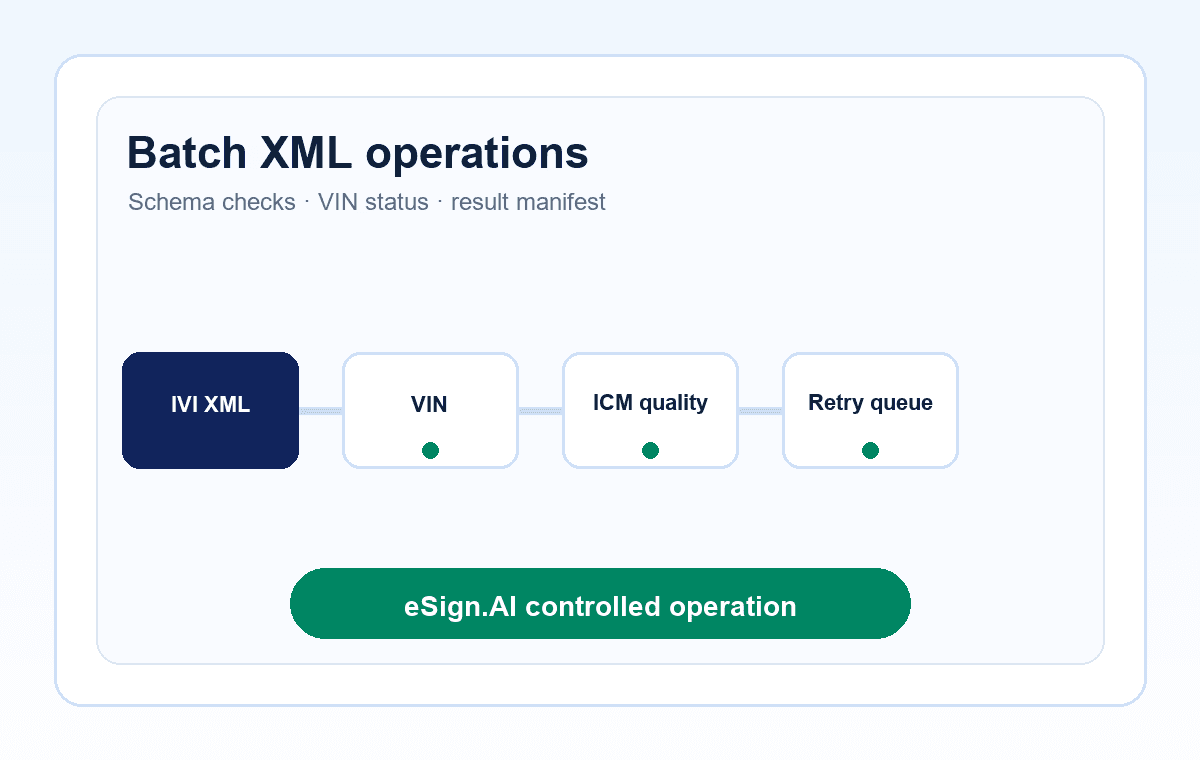
Proses batch XML eCoC dengan pemeriksaan skema, pemeriksaan medan perniagaan, status per-VIN, pemulihan percubaan, dan manifest hasil untuk kumpulan operasi.
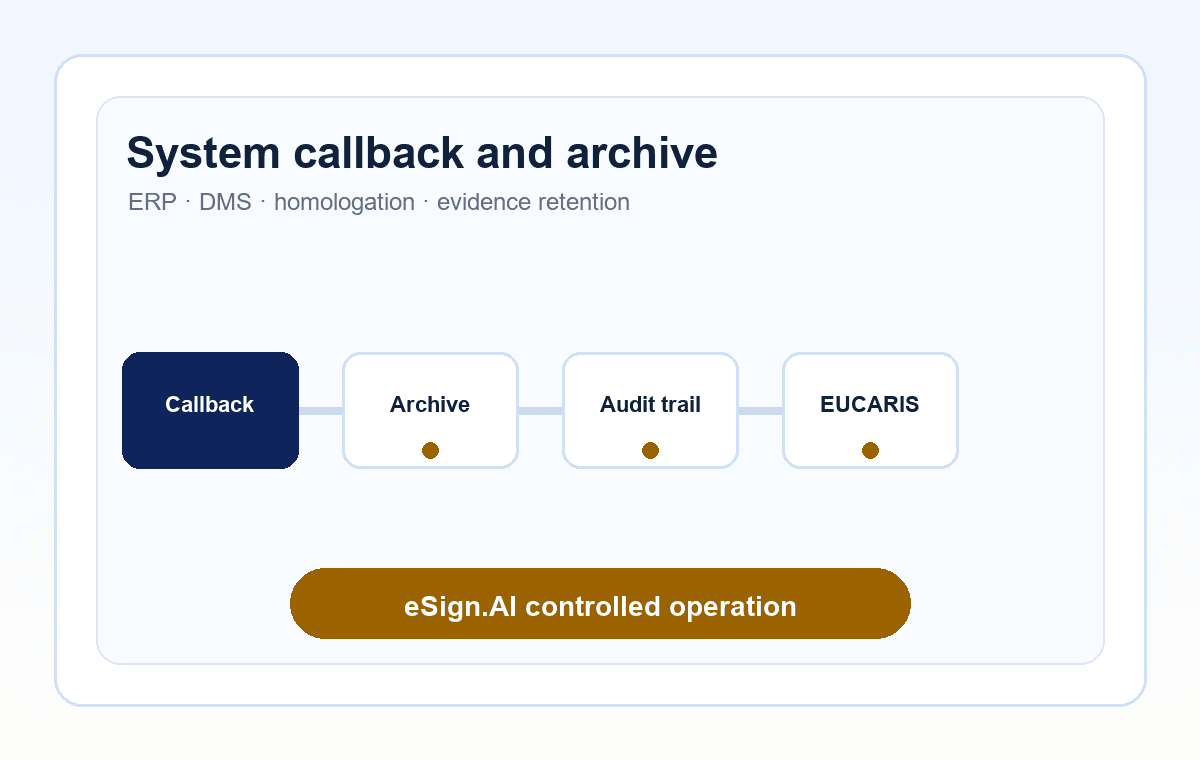
Pulangkan rekod bertandatangan, hasil pengesahan, bukti sijil dan jejak callback status. Arkibkan bukti penyelesaian untuk setiap VIN.
Kesediaan negara
Penerimaan eCoC digital dan pilihan kembali CoC kertas perlu diatur oleh pasaran tujuan semasa perubahan.
| Market group | Examples | What it means | What to confirm |
|---|---|---|---|
| Pasaran NAP yang sedia | Belanda RDW, Jerman | Penerimaan eCoC digital dan kesediaan access point adalah titik permulaan yang lebih baik. | Sahkan endpoint, pertukaran kunci awam, sokongan XAdES, prosedur ujian, dan laluan produksi. |
| Pasaran yang masih bersedia | Perancis, Itali, Polandia | Perancangan eCoC digital boleh diteruskan, tetapi CoC kertas mungkin masih diperlukan untuk pendaftaran. | Sahkan sama ada negara destinasi boleh mengambil data eCoC melalui EUCARIS sebelum produksi. |
| Kesediaan tidak jelas | Sepanyol | Jangan anggap penerimaan eCoC digital sedia untuk semua kenderaan pengeluaran. | Semak arahan negara destinasi dan kekalkan cadangan CoC kertas. |
Pasaran NAP yang sedia
Belanda RDW, Jerman
Penerimaan eCoC digital dan kesediaan access point adalah titik permulaan yang lebih baik.
Sahkan endpoint, pertukaran kunci awam, sokongan XAdES, prosedur ujian, dan laluan produksi.
Pasaran yang masih bersedia
Perancis, Itali, Polandia
Perancangan eCoC digital boleh diteruskan, tetapi CoC kertas mungkin masih diperlukan untuk pendaftaran.
Sahkan sama ada negara destinasi boleh mengambil data eCoC melalui EUCARIS sebelum produksi.
Kesediaan tidak jelas
Sepanyol
Jangan anggap penerimaan eCoC digital sedia untuk semua kenderaan pengeluaran.
Semak arahan negara destinasi dan kekalkan cadangan CoC kertas.
FAQ
Tinjauan kesediaan eCoC
Bawa satu garis kendaraan, contoh IVI XML, nama-nama legal pengeluar, status sertifikat, negara anggota sasaran, dan alur CoC sekarang ke dalam perbincangan kesediaan.
 +852-69190348
 sales@esign.ai
 support@esign.ai
 market@esign.ai
  Perundingan Dalam Talian
